Recently had a buddy recommend I get a Nintendo Switch to be able to play games with him online. Harmless invitation. Friendly. But this is the rationale/dialogue that went through my head:
Hmmm what’s a switch cost?
$200?
I’d rather invest that.
Actually I bet it’s a lot more than $200.
What could that amount to after 20 years!? I bet its a ton.
Yeah I’ll invest the money instead.
A costly mistress
Fact checking: Nintendo Switch $299 from Nintendo’s website or this snazzy bundle from Amazon with the docking station, Mario Kart, Animal Crossing (The Essentials! duh!) etc… is almost $600 at time of writing!
What IS the real opportunity cost of $600 invested? I would likely play the switch for the next 5 years, then it would be forgotten in a drawer somewhere.
If we invested $600 in well diversified stocks through an index fund and got a return of 7%, it would be worth $841. That would be nice to have in 5 years instead of an old video game system….
Investing the $600 instead of spending it (5 Years)
start principal
start balance
interest
end balance
end principal
1
$600.00
$600.00
$42.00
$642.00
$600.00
2
$600.00
$642.00
$44.93
$686.94
$600.00
3
$600.00
$686.94
$48.09
$735.03
$600.00
4
$600.00
$735.03
$51.45
$786.48
$600.00
5
$600.00
$786.48
$55.05
$841.53
$600.00
5 years @ 7% interest growth
But that’s not the whole story. Because after 5 years the Switch would probably be worth some money, but not a lot. Lets say $150. So the net difference is $841-150= $691. Even so, I doubt we would actually sell it. Most things in life we buy and keep until they have very little value remaining or keep them until they stop functioning. Let’s calculate that more realistic scenario.
“Keeping the Switch forever” Scenario
Purchase price $600
Value after 20 years: $0-$50
Net difference: ($600)
Yes the Switch added a little entertainment benefit to our lives, but realistically we already are saturated with possible sources of entertainment. Just Youtube, Netflix, Amazon Prime Video, HBO Max, and Hulu provide so much content that keeping up with your favorite 2-3 shows on each platform is basically a part time job! We are in no way lacking in forms or amount of available entertainment methods.
What would happen if we invested that same $600 for the same 20 year period? Even without opening the calculator.net Investment Calculator, I can tell you 2 things.
We would have more time available to do other things. Buying new toys automatically invites a Time Vampire into your home. It is a hungry vampire and it even has the strength of sunk costs to empower it. We think that because we just bought this new thing that we “should use it”. And we do. That time can never be returned.
We would have more money if we invested than if we spent it. This one is obvious and you can see the trend here, but it’s still worth acknowledging out loud. Do you/do we want another thing taking up space in our lives and in our drawers? Or do we want to employ our dollars to go to work for us?
Investing the $600 instead of spending it (20 years)
start principal
start balance
interest
end balance
end principal
1
$600.00
$600.00
$42.00
$642.00
$600.00
2
$600.00
$642.00
$44.93
$686.94
$600.00
3
$600.00
$686.94
$48.09
$735.03
$600.00
4
$600.00
$735.03
$51.45
$786.48
$600.00
5
$600.00
$786.48
$55.05
$841.53
$600.00
6
$600.00
$841.53
$58.91
$900.44
$600.00
7
$600.00
$900.44
$63.06
$963.47
$600.00
8
$600.00
$963.47
$67.45
$1,030.91
$600.00
9
$600.00
$1,030.91
$72.17
$1,103.08
$600.00
10
$600.00
$1,103.08
$77.22
$1,180.29
$600.00
11
$600.00
$1,180.29
$82.61
$1,262.91
$600.00
12
$600.00
$1,262.91
$88.39
$1,351.31
$600.00
13
$600.00
$1,351.31
$94.58
$1,445.91
$600.00
14
$600.00
$1,445.91
$101.21
$1,547.12
$600.00
15
$600.00
$1,547.12
$108.32
$1,655.42
$600.00
16
$600.00
$1,655.42
$115.88
$1,771.30
$600.00
17
$600.00
$1,771.30
$124.01
$1,895.29
$600.00
18
$600.00
$1,895.29
$132.67
$2,027.96
$600.00
19
$600.00
$2,027.96
$141.96
$2,169.92
$600.00
20
$600.00
$2,169.92
$151.90
$2,321.81
$600.00
20 years, no additional money invested, 7% return
Well lookie here! We are at $2,321! Ok, ok that’s not a ton of money. I agree. We won’t be impulse buying a Maserati with it. But let’s compare the net difference again.
Purchase price: $600
Value after 20 years: $2,321
Net Difference: +$1,721
Toys are fun. Money is more fun.
In other words, we were paid over $1700 just to not spend money on a toy we don’t need. I’m not an advocate for minimalism or abstaining from good and fun things that cost money. Almost the opposite actually. But this kind of long-term thinking helps me actually calculate the cost of our decisions.
Spending $600 isn’t as simple as: “Do I want this object enough to spend $600 on it.” It’s more like: “Is this object so wonderful that I am happy to give up $2,321 to play with it for a few years?”
This doesn’t even factor in the potential implications for early retirement. We aren’t focused on retiring as early as possible, but I AM intrigued by the possibility. In 20 years, having another $2300 invested means we could count on having an additional $92 per year or $7.67 per month for the rest of all time! That’s not a ton of money but it would pay for a couple nice coffees every month during our retirement. If we abstained from 3 more random $600 purchases and had something like $30 per month, we could have a fancy coffee every week for the rest of all time for “free”!
(For reference this math is based on the 4% rule. For more info just Google 4% rule or Trinity Study)
Choose wisely. Move forward! Save lots. Invest often!
If you like personal finance/investing/financial independence and podcasts, here’s mine! : https://anchor.fm/brendan886
Robinhood's Credit Card Just Got Even Better (Somehow) –
Brendan Evan
In someways, I hate to say it, but this is the best credit card I've ever used and it just got better. The only problem is the card is hard to get because you have to be on the waitlist for so long.
Info on the card here: https://robinhood.com/creditcard/
Sign up for Robinhood with my link and we'll both pick our own gift stock 🎁 https://join.robinhood.com/brendab533
Here it is! The long awaited, much anticipated debut of my podcast!! Woo hooo! Ok, no one was waiting or anticipating anything. Ha! Podcasting is such a handy way to ingest information that I felt like it was worth making some content here as well. Listening while driving, running, doing housework, showering, etc… is such an easy way to hack everyday life and increase your productivity. It seems simple to make a podcast, but to do it well takes real effort and craft skills. I don’t have those yet! But I will continue to practice and get better over time!
Topics: This podcast will be about the same general topics that I write about here on this blog and talk about on my Youtube channel: sustainable and healthy ways to improve your fitness and personal finances. These areas of life both require slow, disciplined, sustained action over the course of years to really be successful. I think the nature of that progress being so slow and taking so long is what makes it so difficult. Plus, these are both relatively personal endeavors. We can easily feel ashamed at our lack of progress, extra love handles, or personal loan debt. Instead of stopping there I want us all to be able to learn ways to turn that habit train around and start moving in the right direction. My biggest hope is to help you along that journey!
To know whether or not something as complex as a rental property is worth the risk involves a LOT of factors. This is both the time a rule of thumb is useful and to be viewed with caution.
You may or may not have heard of the 1% rule before but it’s fairlly simple and fairly common, but onoy among real estate investors. The 1% rule states that for a purchase to be considered, the rental rate (per month) of the property should be equal to or greater than 1% of the puchase price. Stay with me! That may feel complicated but it’s really not. Lets look at an example then review it again:
Purchase Price: $200,000
Rental Income: $2,000 (per month)
Rule: 1% achieved!
So this property meets the 1% rule right on the nose. This is rare. More often than not the rule is broken by a price that is too high relative to the rental rate. Where I live in Arizona, rental rates are rarely equal to 1% of the purchase price. A home selling for about $350,000 would likely only rent for about $1800-$2400 per month. This is more like a 0.5-0.7% rule.
So why does this rule “work” at all? Aren’t there a ton of factors to consider like location, how hot the market is, interest rates, property management, the condition of the home, how many bedrooms and bathrooms there are, what the mortgage on the property costs, utilities, THE RENTERS! Yes, those are all big considerations. The 1% attempts to encompass all of that at least as a first checkpoint. It’s easy enough math to do in your head and helps you to know the property is definitely worth considering.
Our home for another example, is worth somewhere between $325,000-$350,000. (Not in it’s current state because I have about 4 projects started and not yet finished. Chaos. Tools and material and bits and pieces EVERYWHERE.) So for it to meet the 1% rule, it would need to rent for somewhere in the realm of $3,250-3,500 per month.
If you’re like me, this prompts a number of questions, all based around the one most important one: Is this enough to make me a profit? Here are the questions that flow through my mind. What is the mortgage payment? Who pays for utilities? How much are taxes again? How much should we set aside for incidentals? Etc… Because renting for over $3k/mo really feels like a lot. That alone is double our monthly mortgage payment! But depending on those other factors, it may not be as profitable as it seems. I would expect the bulk of the utilities to be taken over by any would-be renters. But something like pool care or landscaping should be handled by the landlord, in this case, me! I don’t want the yard, trees, and pool to get neglected by a renter trying to save a few bucks and end up becoming my problem anyway. So that is about $200/mo off the top.
Let’s keep going with this example and talk through some of the numbers:
1% Rule Monthly Rental (gross): $3,250
Landscaping and pool maintenance: -$200/mo
Remaining rent: $3,050
What else is a factor? How about insurance. The average homeowners insurance is around $830/ year but ours is higher at this time. Let’s call it $1100. Apparently landlord insurance is 15-20% more than insurance for your primary residence, so lets forecast $1,320. $1,320/12= $110 per month.
Remaining rent: $2,940
I would never want to personally manage a rental unless the renter was a family member, so we need to factor in the costs of property management too. I have heard a range of costs to factor for PM. Anything between $125/month to 6% of gross rent. 6% of $3,250 would be $195. Lets continue with our conservative figures and call it $200/month.
Remaining rent: $2,740
Mortgage costs are likely the biggest single costs for any property. Unless it’s paid off! But our house isn’t, and as far as I understand, the intent of the 1% rule is to encompass the costs of financing through a mortgage. We currently have a 15-year mortgage so our payment is higher than average. We chose this so we would be force to essentially make an extra principle payment and thereby get out of debt sooner. This is probably even less common in rental real estate because so much of the concern is around cash flow. Cash flow meaning: as much difference between income and costs as possible. If this number is high, odds are you will be making money and more able to keep the property. We could refinance our 15 year mortgage to a 30-year mortgage and massively increase the cash flow. By now we have paid off almost 1/3 of the total balance, so the remaining $127k or so would make for a minuscule monthly mortgage payment. (For the sake of the conversation, a $127,000 mortgage financed for 30 years at a 3.91% interest rate would be $600/mo). As tempting as massive cash flow is, I continue to factor my own financial projections as conservatively as possible. For us to be able to move and rent this house, we would need to be living somewhere else, which means we would have bought another place. The monthly cash flow from this home on a 30-year mortgage would be great, but the crazy cash flow once paid off would be amazing. So let’s do the math with our current mortgage payment. It’s about $1500/mo.
Remaining rent: $1,240
We’re still in a strong position with well over $1,000 left every month. I’m sure there are regular expenses I have overlooked, so as one more category we will add: “small thing(s) Brendan overlooked” for another $150/month.
Remaining rent: $1,090
One of the most opinionated factors to consider remains: capital expenditures. If you want to sound like a guru, use industry terms like “cap ex”. These are the occasional repairs and costs that pop up as part of normal property ownership. Our AC unit is older than I am. It’s bound to go soon. Our plumbing system is made from cast iron (thanks 1970’s construction trends) and is slowly rotting away to nothing. It will need to be replaced in the next 5-10 years. (This hurts even to type in this hypothetical scenario!) Our roof is less than 10 years old but already is missing a few shingles and needs repairs…now! Shoot I need to call a roofer! Our pool is surrounded with “cool deck” which is chipping, cracking, and coming apart. It likely needs refinishing in the next 5 years. The list goes on. These are all expenses we sort of can expect, but don’t have a way to predict perfectly. And there are still others that are lurking and will pop up when we least expect them. For all of these unfortunate but common realities, we need to budget for capital expenditures. How much? Well we basically have to list out the items we know about and how long we think they will last and divide their replacement cost by that amount of time. Then we know how much to factor in between now and then. Confused? Don’t worry, here’s a handy chart!
Item
Total Cost
Lifespan (yrs)
Cost/Year
Cost/Mo
AC unit
$4,000
5
$800
$67
Plumbing system
$10,000
7
$1430
$119
Roof
$400
1
$400
$33
Pool deck
$4,000
5
$800
$67
Water heater/etc..
$500
5
$100
$8
Total
$18,900
$3530
$294
Capital Expenditure planning
All of those costs and timelines are “best guess”. Since I work full time in construction, I feel a little more confident in my estimates, but it’s best to ask pro’s what their normal range of cost would be. Overall the cost is going to be at least $294/month, and it’s probably wise to factor more. This is all of the known and foreseen expenses. EVERYTHING ELSE is not factored in. I would want at least $200-300/mo for incidentals. Again, on the conservative side, we will total this as $294+$300= $600/month
Remaining rent: $490
The next factor that we might often overlook through sheer optimism and lack of experience is vacancy. I never considered this until recent years and the repeated advising of people wiser and more experienced than me! There is virtually no way you will have 100% rental rates. Even if your rental market is hot, really hot, hotter than the sun, you will need some downtime to clean up, repair, or fix anything that’s broken between tenants. A typical factor to consider for vacancy is 10% The average has been closer to 7% nationwide and it varies depending on your area and your particular property. If we lean on the conservative side and plan for 10% vacancy, that means for about 1 month per year we will be getting zero rental income. So one of those sweet $3,250 payments is gone! Poof! If we plan on that and divide $3,250/12 months= $271 per month. Even though this isn’t a “cost”, it’s revenue that is gone and needs to be planned for.
Remaining rent: $219
Wow, how far the mighty have fallen! When you first look at the rental rates by way of the 1% rule it seems like you are absolutely guaranteed to make a ton of money! Yet, after factoring in all of the expenses and forethought needed to actually remain profitable over time, we would only be making $219/month. Now don’t get me wrong. I would love to clear $219 every month after covering every conceivable expense!
But here’s the rub: I’ve NEVER found a property that meets the 1% rule! There are a lot of people who take real estate investing much more seriously than I do and are constantly shopping. Odds are, whatever 1% rule deals that exist are snapped up and purchased before I ever stumble across them. However, the point still stands. These properties are not easy to find and often require the sweat equity and/or cash on your part to take them up to that level of rent. In fact in the market where we live I think this is almost mandatory to get anywhere close to the 1% rule.
The implication I am trying to make here is that just because you found a property that “cash flows” over and above the cost of the mortgage doesn’t make it a profitable investment. If the mortgage payment is $1500 and rent is $1900, you aren’t necessarily making $400/month. Remember to think about all the other costs that come along with owning physical property. As the old saying goes, “You make your money when you buy it”. (Implying that if you buy real estate cheaply enough, the rest of the math works out.)
Do you have any rental real estate?
Do you know someone with a rental?
What do you or they consider when buying a rental property?
Have you heard any horror stories around rental properties? (I feel like everyone knows someone who got burned and now vows never to do anything with real estate again!)
How long do you think a company would stay afloat if it spent more than it made? Months? Years? Ok, that’s a little unfair since many companies have outside investors who are willing to send millions of dollars it’s way to continue operating. Do you have anyone sending you millions of dollars to continue your lifestyle?
Didn’t think so.
Me neither!
But a lot of people live a lifestyle and spend their money as if they did have some outside source of financing footing the bill for their latest impulse. Since we don’t have a Sugar Daddy investor, instead we often turn to other entities willing to help us buy that new Jeep and iPad Pro. There are so many lenders these days under so many names that make themselves SO available to us that it’s hard to even categorize them. Banks, credit card companies, and numerous others continue to successfully market to consumers and convince us that they are the way we should get that stuff we just can’t live without.
In fact, the average American in 2018 had $38,000 in debt, not including home mortgages! And credit card debt is 25% of that amount on average. That’s almost $10,000 in credit card debt alone. With an average interest rate of 18.61%, we are getting absolutely DESTROYED by credit cards.
If you’re in this average situation, it will take over 2 decades to pay off this debt! And that only assumes you stop racking up more and more charges today. (Math is: $10k in debt at 18.61%, paying $300/mo which may be more than many people actually pay.) During your payoff of the $10k in debt, you actually paid over $20,000 total. (So anything you bought was functionally twice as expensive as you thought it was when all was said and done.)
What if you were on the other side of the equation and instead of paying 18.61% interest on top of the money you borrowed, you were EARNING 18.61% interest? If you were the credit card company you’d have made a little over $10k on someone borrowing that money from you and slowly paying it off. But the amount is getting paid off over time and thus the chunk that they can charge interest on is always shrinking. Sounds nice, but we aren’t really getting the feel for how enormous that 18.61% is and how powerful it really is.
What if you could invest that $10k and watch it grow and compound on itself at that same $18.61% rate? Let’s pretend you found a magical stock market index fund that guarantees that rate of growth every year. (This is guaranteed growth is both impossible and doesn’t exist so don’t believe anyone who promises you such firm and distinct gains) The money is growing and growing at this massive rate for the same 21 years it took to payoff that debt at ever-increasing amounts. The first year you get paid a lovely, but relatively modest $1,860. Pretty nice but we are just getting started. By year 5 your interest earnings alone are $3,684. By the end of the first decade the total interest you’ve earned is a cushy $45,122. The second decade is where things really get interesting though. The 11th year’s interest alone nets you more than the whole initial investment at a whopping $10,260. Are you starting to feel the POWAH? (Power) Just wait. Year 15’s interest earnings alone are over $20k and year 19’s are over $40k! At the end of the 21 year period, your $10k turned into a massive beast of $360,000! Sign me up!
Just for fun let’s pretend like this investment was real and you left that $360k for another 19 years for a total of 40 years. You started with that same $10k, earning the same 18.61% you are willing to fork over to any credit card with nice enough rewards and app design. After 40 years, the account would have an insane total of $9.2 MILLION DOLLARS! $9,217,000 actually. This is absurd. That interest rate is absurd. Everyone in the world would be scrambling to invest in that magical fund you found if these returns were possible. (The stock market has averaged around 10% overall, so 18%+ is far better)
The big question is this: Does your desire for a temporary and small lifestyle boost justifyTHAT level of pain? I was assuming before writing this post that a lot of people don’t really feel how insane the rates are that they gladly sign up for via credit cards (and other debt). If you were one of those people I hope you feel it more now. It’s downright absurd. We should laugh in the face of companies who send us “Special Offers” that we are “Pre-Approved!” for their little plastic rectangular thievery devices. We should scoff at them for thinking we are so foolish and gullible.
Obviously I’m not claiming all debt is terrible and must be avoided at all costs. We would have very little chance of ever owning a home if that was the case. Plus mortgage rates are incredibly low, so they are a different situation than optional spending with extremely high credit card rates. We personally borrowed over $180,000 to buy our house a few years ago. That is a ton of money. It puts us well above the average debt level for someone in our age category. The average debt for someone under 35 is $67,400. Doubling that to account for my wife and I puts the average at $134,800. Yowza. We are far behind the curve there. Since the purchase we have paid the mortgage down to about $127,000 which puts us just a little ahead of the average. However, we have ZERO consumer debt. So our entire debt load is being charged at a low rate of 2.875%. Having the payment at all is annoying and our cash-flow situation would be much improved by it disappearing.
While you can’t earn the kind of massive interest on your investments that credit card companies earn on you, you can choose to stop making them richer and start making yourself richer. Paying off any high interest debt (Higher than 5%) as soon as you can and investing as much as possible once that is done will drastically reverse the “Normal” trends that plague Americans. Most of us willfully opt into the kind of limiting and damaging debt that we then have to work so hard to free ourselves from. In a similar, but more time consuming way, we need to opt out of the beliefs that more stuff will make us happier and the only way to make that happen is through consumer debt.
But does that make it a better investing app? I say no.
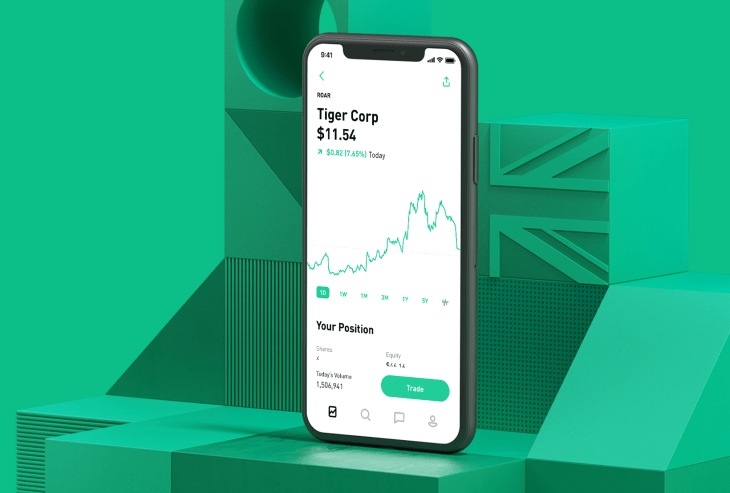
Robinhood has a reported 10 million users. That is a lot of people, many of whom likely would not have started investing were it not for the unique approach taken by Robinhood. But the same features that make it seem attractive initially serve to stunt the financial growth of it’s users. In this post I will lay out why I feel this way.
Ease of use
Limitations inherent in this “beauty over substance” approach actually weaken it’s ability to be a useful tool. Lately I’ve been checking the app a lot. This is one problem: ease of checking your daily progress. Or lack thereof these days! It stimulates day trading, i.e. bad decisions for you. The fact that my work-sponsored 401k is a massive pain to login to, check, make any changes, etc… decreases the likelihood that I jump in and make rash (i.e. stupid) decisions in the heat of the moment.
2. Clean design
The clean design looks really nice, but it lacks some of the detail you likely want. I want to know the expense ratio of the funds that may be worth considering. If one is 0.04 and another is 0.3 and they accomplish similar objectives, why would I choose to pay 7.5 times as much! We need to know this! Make this clear app dev people!
3. Daily updates
Daily updates on how your stock is doing via notifications. + Live graphs for the day + Instant deposits + ease of trades + second-by-second updates on your account balance as the market moves + the generally cartoonish nature of the app all push you toward short term thinking. What emphasis is there on buying and holding for the long term as experts recommend? (Not sales people, experts. Your broker may not have your absolute best interests at heart either consciously or unknowingly.)
4. Emphasis on individual stocks
Perhaps most significantly, the emphasis by default design is destined to direct users toward individual stocks! This means that the vast majority of users will have very poorly diversified portfolios. Remember, for now the option of fractional share investing is not available to anyone but the select few people who have been given early access. So I am stuck with a few of this stock and a handful of the other. Perhaps we can force ourselves to wisely branch out and buy a multitude of companies in a sector, but I am partial to believe that most of us probably chose to stick with simply buying more shares in the few companies we started with. This mean we pigeon-hole ourselves into extremely limited diversity and high risk. This design actually ensures that the vast majority of Robinhood investors get WORSE returns than if the emphasis was on low cost index funds. Remember, index funds are available on Robinhood, you just have to search them out.
5. Gamify the process
Also, the game-ifying of the app make it feel less significant. It feels a little more like a cheap app store game about investing than actually risking your literal hard earned dollars. If you’re like me and are a sucker for games, especially pseudo games that involve numbers, something like Cash Management waiting process is a little too intoxicating. For the unfamiliar, Robinhood is starting to dole out a debit card to a limited number of it’s users. When I first started using the service, I was number 1.2MM in line. Every day you’re allow to tap the screen up to 1000 times, which moves you “up in line”. Also, at somewhat random times you may take a massive leap in line, 10,000-40,000 positions in a day. Obviously another incentive they have for this is to allow any new signups that came from your referral link to move you up in line. I’ve not gotten any referrals so the impact of this on your place is unknown to me. This of course entices you to login daily, invite friends, and generally form a habit of visiting that peaceful minty-green app icon every day.
All of this is fine if you’re a bastion of self discipline. Perhaps you’re not like me and you’ve got ice water flowing through your veins. Perhaps you never cheat on a diet or miss a workout. Perhaps you always keep the promises you make to yourself. This whole post could be a list of complaints about an app that is perfectly neutral and I could be completely wrong. BUT. My guess is that you aren’t a Navy Seal with laser focus on whatever you set your mind to and you are subject to the temptations baked into this kind of design. Watching the market sway it’s hips back and forth like the motion of an expert salsa dancer may just hypnotize you into joining in this dangerous dance of daily trading.
Please don’t misinterpret this post as a binary bashing of a beautiful and generally beneficial app and service. These kinds of things aren’t able to be boiled down to “good” and “bad”….most of the time. (There may be some genuinely scammy or otherwise unethical investing apps and services out there that we legitimately need to avoid like the plague….err virus) I still think Robinhood is the path of least resistance to those that are new to investing. HOWEVER, the easiest path is rarely the best when it comes to adult life. It still overlooks many of the fundamental features I have come to believe are foundational for any financial friends to be able to finesse. Again, fractional shares. Yes, yes, they have the feature and are slowly rolling it out to a select number of users. But again, it’s not available to the public so you are more mentally tied to a stock price than an amount of money you’ve committed to investing and its growth or shrinkage based on percentages.
Also, the lack of IRA options is a bit staggering to me. The fact that we are forced to only operate within taxable accounts and are not able to access tax-advantaged accounts is a massive oversight. The average Robinhood user is younger than most of the investing populous as a whole. Likewise, we are prone to be earning less than the average investor and to have a longer time horizon for our investments to grow. Compound interest has been touted as a wonder of the world, and yet here we are being funneled into a short-term, poorly diversified corral of investing.
These reasons are why my favorite investing app is M1 Finance. It corrects all of these wrongs without creating obvious gaps that I miss. Even so, I find myself spending more time on Robinhood because of its ease of use and design features. However, if I had to delete an investing app TODAY and never use it again, sending all of the funds to another service…it would be Tastyworks. But right after that it would be Robinhood!
Starting at the worst possible time to invest: literally.
When I wrote Part 1 of the $2000 Passive Income Experiment, the stock market was booming along with virtually every other market. Not long after, Part 2 of the $2000 Passive Income Experiment laid out what indexes and companies I am investing in. At that time public sentiment was positive and cash was flowing. Almost immediately afterward, things changed drastically. Global infection rates of COVID-19 became topic of public conversation and a resulting stock sell-off began.
SARS-CoV-2
Besides generally being afraid for their own health and wellness along with the health of loved ones, the accompanying sentiment is that people will need to be quarantined and thus, not spending money like they normally do. This of course is true, is happening, and the effects are easily visible in the market. Profits have dropped, valuations have dropped, and general business outlook has dropped.
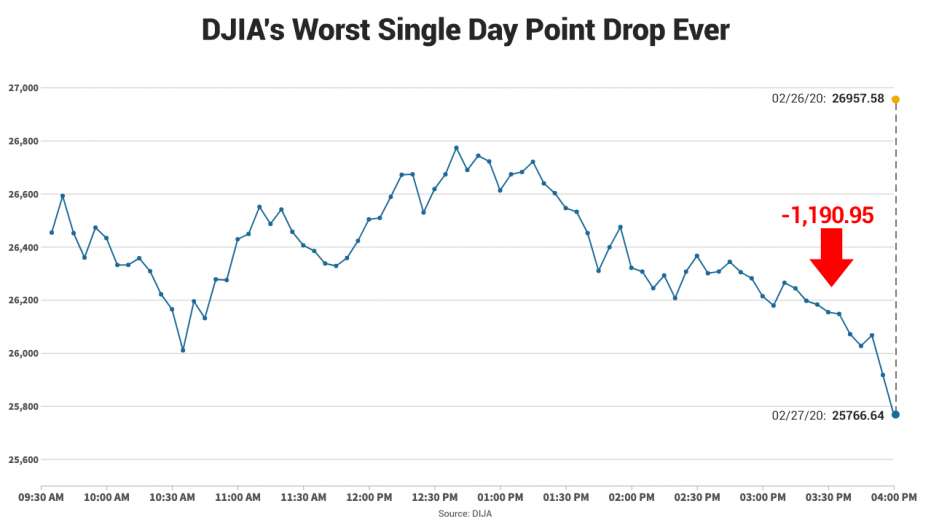
This is not an inappropriate response. As much as I personally dislike the effect it has on everyone’s finances, it makes sense. We are regularly setting of the stock market’s “circuit breaker”. Here’s a breakdown of when that happens via Vanguard’s website:
Level 1 halt (7%)
Trading will halt for 15 minutes if drop occurs before 3:25 p.m.
At or after 3:25 p.m.—trading shall continue, unless there is a Level 3 halt.
Level 2 halt (13%)
Trading will halt for 15 minutes if drop occurs before 3:25 p.m.
At or after 3:25 p.m.—trading shall continue, unless there is a Level 3 halt.
Level 3 halt (20%)
At any time during the trading day—trading shall halt for the remainder of the trading day.
We’re responding so quickly to the anticipated future that we actually have to have these speed bumps in place to slow things down. (“We” meaning, humans. Not necessarily me or my community in particular. I like to think of us all in the same boat, especially in light of a pandemic.)
This has meant that the value of all of the dividend investments I chose a couple months ago has plummeted. “But wait”, you may interject, “aren’t these dividend paying companies? Shouldn’t the value of the stock NOT be your primary concern, since they were specifically chosen for their regular dividend distributions?” Why, yes dear reader, you are correct.
It’s been a difficult ride emotionally to see the valuations drop, but the dividend is why we came here in the first place. So, how’s the dividend payout been so far? To put it bluntly, it feels a bit like I’m playing an uneventful game of hide-and-go-seek with dividends. Somehow I thought the game would start earlier. And move quicker. And be more exciting. In general, I’ve only gotten a handful of very small dividends.
First: The individual companies I chose through Robinhood have paid a total of 4 dividends. They are:
XOM: February 10, dividend of $0.87/share X 2 shares= $1.74 total received
MMM: February 13, dividend of $1.47/share X 1 share= $1.47 total received
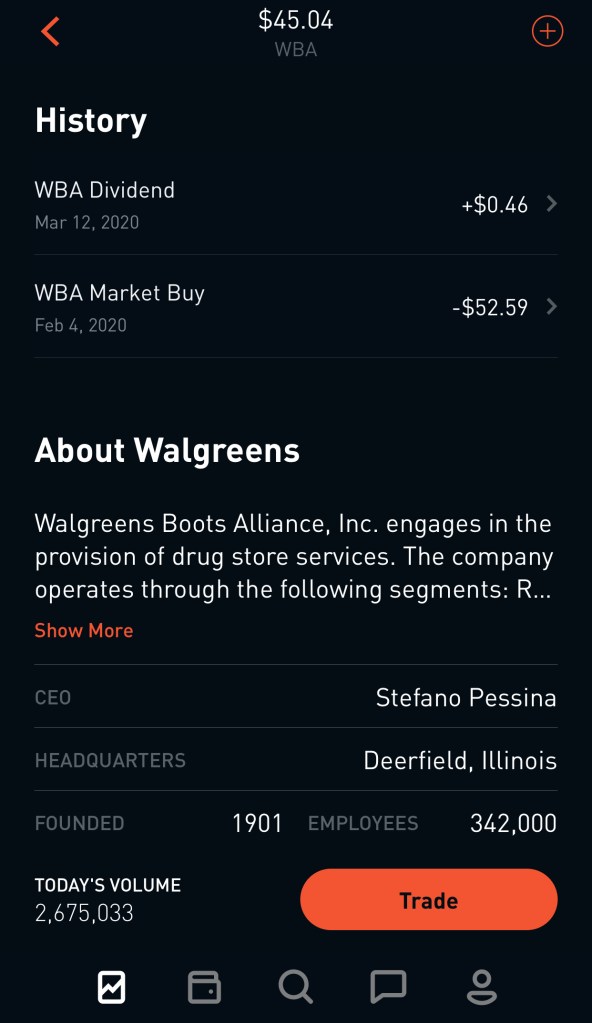
WBA: February 18, dividend of $0.46/share X 1 share= $0.46 total received
PSEC: February 27, dividend of $0.06/share X 2 shares= $0.12 total received
Total= $3.79
Total dividend return 0.38%
Robinhood continues to be the simplest, easiest, most intuitive investing platform by far. It is very clear what is happening with each investment you choose and when an upcoming dividend is scheduled. Then once the dividend is paid, it is clearly shown on your summary for that particular stock. Here’s what Walgreens looks like when I scroll to to the bottom of the screen:
Robinhood app clearly showing dividend amount and date.
The dividends paid so far by these companies have been about on track with my expectations. However, the dividends for the rest of this calendar year should be far less than expected. The negative effects of COVID-19 will likely hit profits hard for all of these companies, with the exception of Walgreens. It may actually benefit financially!
Second: Diversified funds chosen to pay dividends through Webull
If you remember from Part 2 of the $2000 Passive Income Experiment, the goal with these investments was to gain significantly more diversity than the ones chosen with Robinhood. These funds hold many different companies, so the rise or fall of a specific stock is not felt as much. My assumption was that this would prove to be the winner in the long run, but with the outbreak of COVID-19, it feels like there won’t be a winner as much as an investment that loses less!
Thus far, no dividends have been paid from these investments! At time of writing technically the end of the first fiscal quarter has not come, so that may be the point at which many companies and funds normally would pay their first dividend of the year. In any case, I’m not planning to sell these investments any time soon so we should have plenty of time to see what happens in the future.
The dry, empty status of my indexes dividends Photo by icon0.com on Pexels.com
Also, Webull isn’t as anxious to tell you everything that happens the moment it happens like Robinhood. They are more “old school” when it comes to updates and changes to your account. One of these areas seems to be dividend payouts. Robinhood makes a push notification appear, shows it on the “Messages” tab, and files it on the page of the stock itself (when you view it on your device). So you can’t really miss it. Webull (I trust!) only shows dividend payouts on the monthly statement after it’s happened.
The roller coaster of volatility in recent days and weeks is one of the reasons why dividend investing seems interesting to me. As long as companies still agree to pay their dividend, the price of the index or stock itself sort of doesn’t matter. Thus far the start of this experiment has been slow, but I anticipate it picking up in the near future!
But, Mousie, thou art no thy lane [you aren’t alone] In proving foresight may be vain: The best laid schemes o’ mice an’ men Gang aft a-gley, [often go awry] An’ lea’e us nought but grief an’ pain, For promised joy.
-Robert Burns’ poem, To A Mouse, 1786
When starting this experiment I hadn’t even considered the possibility of a stock market correction on the scale of 35%+. Honestly it was a mix of foolish optimism and a lack of experience. For my entire investing lifetime it’s been a bull market. Before 2009 I didn’t have money to invest anyway. Everything was immediately spent! Now that I’m allegedly older and wiser, a significant portion of our combined income goes to investments but I have to admit that this downturn has been an emotional workout!
Enough gloom and doom! Let’s get back to the real content of the experiment at hand!
In this post I’ll outline the specific stocks and funds I chose, why I chose them, and what I anticipate the outcome to be overall.
First: Dividend-paying indexes
Our first group contender is the $1000 invested with Webull into dividend-paying indexes. If you’re not familiar with the concept of an index, here’s a very short explanation. An index is just a group of stocks chosen based on whatever parameters people want, all grouped together into one basket. You buy a portion of the entire basket, getting the benefits of diversifying with all those stocks inside it.
Still feel a little confused? Me too….let’s think about it in terms of pizza!
Photographer Victor Protasio, Food Stylist Rishon Hanners, Prop Stylist Sarah Elizabeth Cleveland
The ingredients of the pizza represent stocks. Flour, water, salt, pepperoni, sausage, tomato, oregano, cheese, olives, onion, etc…. Choosing individual stocks is like just buying the cheese or the salt or a little piece of sausage. If they are really awesome (i.e. increase in value/pay regular dividends) then maybe you’d be happy with just eating them alone. But if you want all of them combined, you would have to go out and buy specific amounts of each to aggregate yourself. That’s a lot of work to find what you want, how much of it you want, and buying it all in pieces.
In contrast, an index is just buying the whole pizza. Its assembled for you with all the right ingredients based on what you ordered. Ah you like the pizza based on the S&P 500? Here you go. Only want the dividends and don’t care about growth, there’s a pizza (index) for you. Whatever your flavor, there’s an index already hot and ready and waiting.
The benefits are that an index is simple, automatically diverse, and readily available. It’s a powerful tool that you can take advantage of now and don’t even need to hire a fancy high-powered financial guru to manage.
“By periodically investing in an index fund, for example, the know-nothing investor can actually outperform most investment professionals. Paradoxically, when ‘dumb’ money acknowledges its limitations, it ceases to be dumb.”
(Warren Buffet, 1993)
I chose a small handful of indexes that are made to follow dividend paying companies. This way I get to take advantage of all of them simultaneously! Here they are:
VIG: Vanguard Dividend Appreciation ETF
VYM: Vanguard High Dividend Yield ETF
JDIV: JPMorgan U.S. Dividend ETF
VIG: Vanguard Dividend Appreciation ETF
Vanguard has always been a go-to investment group for people looking for low fees and great returns. They LITERALLY invented the index fund for this purpose. VIG is a fund that is designed to track another index called the NASDAQ US Dividend Achievers Select Index. That index chooses investments with at least ten consecutive years of increasing annual regular dividend payments. Sounds good to me! On top of that, the expense ratio is a teeny tiny 0.06%! That’s about as close to totally free investing as we are going to get! It holds 186 different stocks and most of them are big names you’ve definitely heard of. Like these:
Month-end 10 largest holdings (35.50% of total net assets) as of 02/29/2020
1
Microsoft Corp.
2
Visa Inc.
3
Procter & Gamble Co.
4
Walmart Inc.
5
Johnson & Johnson
6
Comcast Corp.
7
McDonald’s Corp.
8
Abbott Laboratories
9
Medtronic plc
10
Costco Wholesale Corp.
Sector
Basic Materials
3.6%
Consumer Goods
10.6%
Consumer Services
20%
Financials
11.5%
Health Care
11.9%
Industrials
26.2%
Technology
9.9%
Utilities
6.3%
JDIV: JP Morgan U.S. Dividend ETF
I only chose this ETF because I needed to round out the $1000 total and the price was just about right to do that! I did almost no research to choose it besides noticing the famous name (JP Morgan) and the fact that it held over 200 companies. It turns out that it’s a very small ETF with only about $34 million in holdings. Thankfully, it’s well-diversified over a number of sectors and companies! It is also inexpensive to own with a net expense ratio of 0.12%! That means they only charge you $1.20 for every $1000 invested.
JDIV Top 10 Holdings
As of 03/25/2020
Symbol
Name
Security Identifier
% of Net Assets
Market Value
CLX
CLOROX CO/THE COMMON
189054109
0.84%
216,351.96
GILD
GILEAD SCIENCES INC
375558103
0.82%
211,836.06
DLR
DIGITAL REALTY TRUST INC
253868103
0.82%
210,802.48
CY
CYPRESS SEMICONDUCTOR
232806109
0.80%
206,885.00
LLY
ELI LILLY & CO COMMON
532457108
0.80%
205,346.96
AMGN
AMGEN INC COMMON STOCK
031162100
0.79%
202,410.72
INTC
INTEL CORP COMMON STOCK
458140100
0.78%
201,861.88
VZ
VERIZON COMMUNICATIONS
92343V104
0.78%
200,209.46
JNJ
JOHNSON & COMMON
478160104
0.77%
199,278.60
GIS
GENERAL MILLS INC COMMON
370334104
0.77%
197,271.00
Sector Exposure
As of 03/25/2020
Sector
FUND
Basic Materials
9.5%
Consumer Goods
15.1%
Consumer Services
7.9%
Financials
16.4%
Health Care
7.6%
Industrials
9.5%
Oil & Gas
5.5%
Other
0.0%
Technology
6.4%
Telecommunications
3.7%
Utilities
18.9%
VYM: Vanguard High Dividend Yield ETF
VYM is yet another index that’s made to track some other index. It is designed to track the FTSE High Dividend Yield Index. Unlike the FTSE index it is made up of domestic stocks, but holds a very similar ethos of only holding dividend-paying companies. Like the others, it’s made up of many different companies so all of your eggs aren’t trusting the same proverbial basket. For example, at the end of February the top holding was a tie between JPMorgan Chase & Co and Johnson & Johnson at 3.80%. So even if Chase absolutely plummeted, it’s less than 4% of the whole. The 10 largest holdings in the index make up less than 27% of the total, which gives you an idea of how small each piece of the pie really is. I view this as a good thing. Yes, it’s less likely to have a rocket ship company make me a millionaire overnight, but that also means it’s likely to handle the market downturns better as well.
If you care to compare, there’s the break-down of the different sectors of companies in this index fund:
Portfolio composition
Equity sector diversification
Sector
High Dividend Yield ETF as of 02/29/2020
FTSE High Dividend Yield Index (Benchmark) as of 02/29/2020
Basic Materials
3.30%
3.30%
Consumer Goods
14.40%
14.40%
Consumer Services
9.20%
9.10%
Financials
18.30%
18.30%
Healthcare
14.10%
14.10%
Industrials
8.30%
8.30%
Oil & Gas
7.10%
7.20%
Technology
10.60%
10.50%
Telecommunications
5.20%
5.20%
Utilities
9.50%
9.60%
Whew! Lots of numbers. Just a few more: About 98% of this part of the investments are in the 2 Vanguard funds, with a tiny bit of that oddball JDIV bringing up the last 2%. The point of this exercise is to test how easy it is to just pick 1-2 (or in my case 3 just to round out an even $1k) indexes and “set it and forget it”.
Second: Picking specific companies that pay dividends.
This is what it feels like to me when anyone picks an individual company. Or even a handful of individual companies. I’m FAR from a financial analysis guru, but even people who make a successful career from analyzing companies financial standing can’t accurately and reliably pick winners. The fact that the pro’s lose to “the market” as a whole over 95% of the time makes me realize how small of a chance I actually have to do that kind of thing.
For the purposes of this experiment I picked dividend paying companies that the Interwebs claim are worth considering. Once you type things like “dividend stocks” and “passive dividend investing” into Google, you get a lot of very direct advise (and a lot of people wanting to sell you their opinion) on where to invest your hard earned money.
A lot of people claim the “Dividend Aristocrats” are a sure-fire way to succeed. So I considered those. Others have hot picks based on the current state of the market, of consumer sentiment, of perceived demand, or any other number of factors. Knowing that the pros don’t generally taste success with a TON of smart analysis made me feel like I was partially off the hook when it came to pouring over prospectus statements and P/E ratios and all the other paperwork available. I went with what made sense at the time and didn’t look back.
SO, who did I choose. These lovely companies:
F: Ford
ABBV: AbbVie
AOS: A.O. Smith
MMM: 3M
PBCT: People’s United Bank
WBA: Walgreens
XOM: Exxon Mobile
T: AT&T
PSEC: Prospect Capital
The only company that I didn’t choose strictly on the recommendations of logic and anonymous internet brethren was Ford. I like their vehicles. I’ve also wanted to invest in them since 2010, and have regretted not since at the time the stock was only $2.00/share. It’s risen a lot since then and has paid dividends along the way.
You’ve likely heard of a handful of these companies and have an idea of what they do. I’d never heard of PBCT or PSEC. People’s United Bank is a bank and financial holding company doing….bank sounding stuff. (Insert shrug emoji here!) And Prospect Capital is a business development company that basically lends money to companies or invests in them directly. Anyway, enough about them.
In next week’s post I’ll share how the results have fared thus far. Fair warning: it is NOT pretty.
SO many little quips revolve around saving money. I feel like the implication is that they somehow summarize everything you need to know to handle your money well.
But that’s bogus! Money is complicated. Or at least our lives are complicated so the way we choose to deploy our money is also complicated. That’s why I think we need to think with a little more nuance about what saving our money is for and what it can never accomplish.
FIRST: Why saving money is great essential! And a little childish…
Spending everything we make (or more) is a losing proposition. We can never catch up, pay off debt, create a secure financial footing, build wealth, or hope to have the option of retiring from full time work. If that’s the place you’re currently in: no shame and no blame. Not from me, not from yourself, not from anyone else on the internet. Yes it’s an objectively bad habit to be in but shame/blame/built aren’t going to help change things.
So we are left with the next logical step which is to save some portion of our income. I.E. intentionally spending less than we make so we can set it aside. Wisdom. Delayed gratification. All that jazz. But hearing things like “pay yourself first” honestly has only served to cloud my mind in years past. What the heck is that supposed to mean!? (I finally learned that it is just a cryptic way of saying you should save some money before you start spending it on non-essential items)
I used to save money in a wooden and plexiglass kids bank shaped like a dog. His belly was see-through since it was made of plexiglass and you could see the little coins and bills piling up over time. To access them you had to literally disassemble the thing with 9 tiny screws. But that’s what I did countless times! I couldn’t wait to let the money pile up. Having to count it over and over I’d grab a tiny screwdriver and take it apart to get my new total. Then it would get carefully reassembled and put back on the shelf.
Stashing some money in cash or even in a savings account is really not much different than my childish activities 25+ years ago. We know it’s the right thing to do and put some money off to the side. It has no real intent or purpose, but its there and we are doing what we’ve been told is the “right thing”. The problem is that we don’t have much of a grasp on what’s happening overall, which doesn’t allow for intention to be baked into that savings, which limits its power to help us.
We need a general game plan. I’d summarize that as: have an accurate budget, have a plan for debt repayment, and have a plan to grow your wealth. Saving money needs to have a direction into 1 of these 3 buckets or it will be stuck in that aimless, child-like state like my doggy-bank dollars.
SECOND: Saving is a foundation. But only a foundation
Assuming we have a budget, a plan for debt, and a solid vision for a wealth-building future do we just save as hard as possible? Yes and No.
Saving is the first step in the process of wealth building. We have to hang onto money and not let it fly out the door to subscriptions and restaurants and nasty bills. It is the only way we can stop the cycle of living paycheck to paycheck.
We all need a small chunk of money that is a basic buffer while money flows in and out of our accounts so as to avoid bouncing a payment. This can be as little as a few hundred dollars or as much as a few thousand depending on your comfort level, when bills are paid, and how big those bills are. If you want a good buffer, have everything set on autopsy for the 1st of the month and spend a lot on recurring bills you may need $3000-$6000 as a buffer. But if you’re ok with a tighter budget, have bills spread out across the month, and don’t have many large expenses you could probably get away with $500-1000 quite comfortably.
After a buffer, everyone needs an emergency fund. Actually your buffer is the start of your emergency fund because it’s the bare minimum in whatever account(s) you use. In a real emergency it’s likely the money that gets spent first. But over and above this an emergency fund should be set aside in it’s own account, distinctly earmarked for emergencies only. “Emergency” means unpredictable, accidental, or otherwise out of your control. If it IS in your control or can be foreseen that falls into the next category of “sinking funds” but more on that in a minute.
An emergency fund is directly proportional to 2 elements. 1: What comfort level are we after? 2: What are our average monthly expenses? For number 1, this is literally a matter of preference. Part of that preference has to do with how regular income is for the household. The more variable the income, the larger the emergency fund should be. However, most people outside of commision-only jobs are paid fairly regularly. Number 2 is important because the amount of emergency funds we need to set aside depends on how fast it will be used. If you’re a high income/high spending household that’s much different than a single student living at home.
Rules of thumb for emergency funds: Always have at least 1 month of living expenses. Set a baseline goal after that of 3 months worth of living expenses. If your income is wildly variable, bump that baseline goal to 6 months or equal to the average span of your sales/paychecks. Any more than these amounts and you’re probably giving up a lot of wealth-producing potential! Unless you’re saving for a specific upcoming need: a sinking fund.
Third: Saving for a “sinking fund” (aka rainy day)
This area of saving stands to lift the most people out of the evil clutches of consumer debt and I to the glorious paradise of freedom: saving for big purchases. Wait! Stay with me! Don’t turn away because you just threw up in your mouth a little bit like I did thinking about this particular topic! I know it’s repulsive or at least horrifically boring to slowly and methodically save for a premeditated purchase months or years in advance. I get it. But we have to do something new to get a new result.
We have to do something new to get a new result.
-Me…again
If you bought a house and expect the air conditioner to kick the bucket in the near-ish future but don’t save for it, that’s just silly. (This is what my wife and I did by the way, we bought that house. 3 years in and the old thing is still somehow functioning!) Or if the current vehicle is steadily creating more and more bills from the mechanic shop we have to acknowledge that reality with a plan. And plans often take time to come to fruition.
We are responsible for our financial futures so it’s our responsibility to forecast the big expenditures. Making a quick list in a phone app or notepad with the impending biggies for the next 1-3 years can add huge amounts of perspective. With it, we are better able to act in the present. “Can we afford to go on that 2 week cruise” becomes easier to answer if Christmas is around the corner along with a new washing machine.
Keep your list handy and update it often. It’s easy math to figure out how long it will take to save for an upcoming purchase. (The math is easy. The saving is harder!) Let’s say an expense is coming up in about 5 months. It is going to cost around $900. $900/5= $180, so every month from now until the big purchase we need to set aside $180 and not touch it! That can be the hardest part, seeing the funds accumulate and leaving them alone, destined to fulfill their true purpose.
Saving for these bigger expenses can take a lot of the sting out of them plus it saves huge amounts of interest in the long run. If you charged that same $900 on a credit card with a 19% interest rate and only paid $50/month, it would take you almost 2 years to pay it off! (22 months of torture, knowing that giant company is taking your hard earned money just because you didn’t save for it in advance). Worse than that, instead of it costing you exactly $900, it costs over $1067!
So far we’ve established significant security by way of cash savings. (By cash that of course includes and presupposes using a bank and a high interest savings account…not literal paper currency.) But stopping here is why “saving” can be terrible. Stopping at saving and choosing not to invest our money grossly limits our wealth building potential.
CALLING ALL MILLENNIALS: Do not stop here!
Lets review a few stats:
Yes, 58% of millennials have less than $5,000 in savings. That’s not an insignificant sum. But its not massive either. The problem is that saving money is where many of us stop. We think that is the proverbial finish line. To have a lot of cash piled up like Scrooge McDuck means we are secure.
60% of millennials and Gen-Zer’s define financial success as being debt free. Again, in concert with a pile of cash this “feels” like an indicator of success or completion. We want to have zero debt and the foundation of cash at our fingertips. This is not a big enough or accurate enough goal. We need to think bigger!
Millennials have an average net worth of $8000. Here, we start to see a little more into the depths of the problem. Having that cash-heavy plan that is focused on accumulating more in the savings account and paying off all those debts leaves our growth at a snails pace. A net worth of $8000 means we are barely above ZERO. And without investing we are doomed to stay near there. Your wealth accumulation is limited to your earning power if you refuse to invest. (Sources: https://www.businessinsider.com/average-millennial-net-worth-compared-to-other-generations-2019-5)
21% of all millennials on average have invested less than $500. Ever.
Overall, 54% of millennials have invested less than $5,000.
So that’s a total of 75% of “us” that have only parted with between $0-$5000. We are not setting ourselves up for the kind of future we want. (This isn’t the time to discuss income inequality for younger generations as compared to previous generations, but of course that plays a large role. Regardless, the stats show that most younger people are very conservative with their financial planning, detrimentally so). (Source: https://finance.yahoo.com/news/43-millennials-aren-t-investing-090000387.html)
Your wealth accumulation is limited to your earning power if you refuse to invest.
-I’ve got to find someone else to quote. Me again.
Instead, if you take a tiny step into the world of responsible investing through an employer sponsored 401k, a personal Roth IRA, or similar tax advantaged account, your wealth accumulation powers are compounded and multiplied far beyond the amounts you are paid every month. Many of us are too conservative in the wake of 2008-2011. We saw people who were “investors” lose a lot of money and feel determined to be wiser than they were. But think about how vague that is: who are these investors? What were they invested in? How diversified were their investments? How much is a “lot of money”? Did they make that money back over the last decade?
It’s like your first breakup. It hurts, its terrible, its debilitating…for a time. But if we resolve never to be hurt again and thus rule out all relationships with human beings then we also miss out on the beautiful intimacy, joy, growth, and love they very often bring.
Our investments will hurt us a little from time to time but over the long haul they will do so much more good than harm. We need to do a little research, approach things carefully, then break up with “Savings” and marry our newfound love “Investment”, never looking back. Yes this analogy got weird fast, especially because we need to continue to save along the way but you get the point.
One more quick example:
Jill and Betsy are twins. They mirrored each-other’s educational and career paths. Both were hired for identical jobs, have the same costs of living, and the same income. Jill is a traditional millennial and saves $500/month after paying bills, making debt payments and saving for some larger purchases. The money goes directly into her savings account at the bank where she’s had an account for most of her life. “Investing is risky” she tells herself. She can’t afford to risk the hard earned money she makes so she keeps it “safe” in cash. After 30 years, Jill has contributed $180,000 to her savings! Nice work! However, the bank has not appreciated her diligence and the trivial interest rate of 0.1% they offer has only gained her an additional $2,718.
In contrast, Betsy is a non-traditional millennial and reads a few books, listens to some investing podcasts and checks out an interesting new blog called “Abacus Personal Finance”, all finally convincing her that investing is the way to go. She opens a Roth IRA at a brokerage with zero fees and shovels the same $500/mo into an index fund tracking the whole stock market. After 30 years, Betsy has contributed the same $180,000 her sister Jill did. But the results of her investing are astonishing. She has a balance of $1.09 MILLION! What a massive difference! The companies she invested in through her index fund have rewarded her with a cumulative $910,000 in interest!
We cannot afford to stay stuck in our “savings-only” mentality. If we do it will be the worst limiting factor for our financial futures despite an otherwise solid game-plan.
Stick around for more posts in the future on investing and just how easy it can be to get started!
If you want a 1-stop app/website to track all of your accounts including banks, debt, mortgage, investments, and anything else in your financial life, I recommend Personal Capital. It’s 100% free and I’ve been using it since September 2017 and love it. By far the easiest way to track your net worth and all accounts in 1 place. Full transparency: if you start using it with my link below we both get $20. If you don’t use my link neither of us gets $20. Also, it really is free but they will “offer” you their own services or investment recommendations every now and then. They probably have good things to say and overall trustworthy recommendations, but I want to keep it free so I’ve not used any paid services or investments they advertise. Link: https://share.personalcapital.com/x/sLcqkA
Amateur trail runner with a dream of one day completing an ultra-marathon
Driving enthusiast (though, with no current outlets for this)
Rock climber, adventure seeker, fun lover
Passionate about helping people better understand personal finance and investing basics
So why are we here, online together? Conversations kept happening in person about personal finances, investing, budgeting, and general financial planning. Family, friends, and coworkers all were so eager just to talk openly about money for once. We had awesome conversations about saving money, how to invest, teaching kids about money, retirement planning, real estate, and more. It was so refreshing to experience this and it just kept happening!
The wheels in my head started turning….if we are having these productive and enlightening conversations where we all benefit in person, I wonder if people elsewhere would also like to talk. I wonder if they are experiencing a distinct avoidance around money with their friends and family. Maybe they, like us, have questions and don’t really know who to believe for the answers.
So I started a Youtube Channel and Instagram account: Abacus Fitness and Money. The goal was and is to talk about the basics of exercise and money in a way that is non-threatening, simple, and helpful to everyone. But making video content is a ton of work and was taking a lot of time away from the very personal relationships that spurred on the creation of the accounts to start with. In the meantime I kept writing. And writing. Notes about books, helpful tips from podcasts, articles to reference in later conversations, questions I had, ponderings about estate planning, and more! But you can’t post a bunch of words to Youtube or Instagram. Hence, the blog!
This is a place where I hope to add the most value to someone like myself who is prone to reading and writing and wants to engage in real conversations about the topics they are most interested in around personal finances. Being a millennial, much of my writing will be from that perspective but a lot can apply to anyone. Plus if you’re in a unique or different situation we can talk about that too.
This is a safe place to question what we have heard and look to learn more. I do not have all the answers. I want to learn along with you. In the meantime I will share my experience, the good sources of information I’ve found, and anything else that can add value to your life and your pursuit of financial wellness.





















 Abacus Fitness and Money