Part 3: $2000 Passive Income Experiment

Starting at the worst possible time to invest: literally.

When I wrote Part 1 of the $2000 Passive Income Experiment, the stock market was booming along with virtually every other market. Not long after, Part 2 of the $2000 Passive Income Experiment laid out what indexes and companies I am investing in. At that time public sentiment was positive and cash was flowing. Almost immediately afterward, things changed drastically. Global infection rates of COVID-19 became topic of public conversation and a resulting stock sell-off began.

SARS-CoV-2

Besides generally being afraid for their own health and wellness along with the health of loved ones, the accompanying sentiment is that people will need to be quarantined and thus, not spending money like they normally do. This of course is true, is happening, and the effects are easily visible in the market. Profits have dropped, valuations have dropped, and general business outlook has dropped.
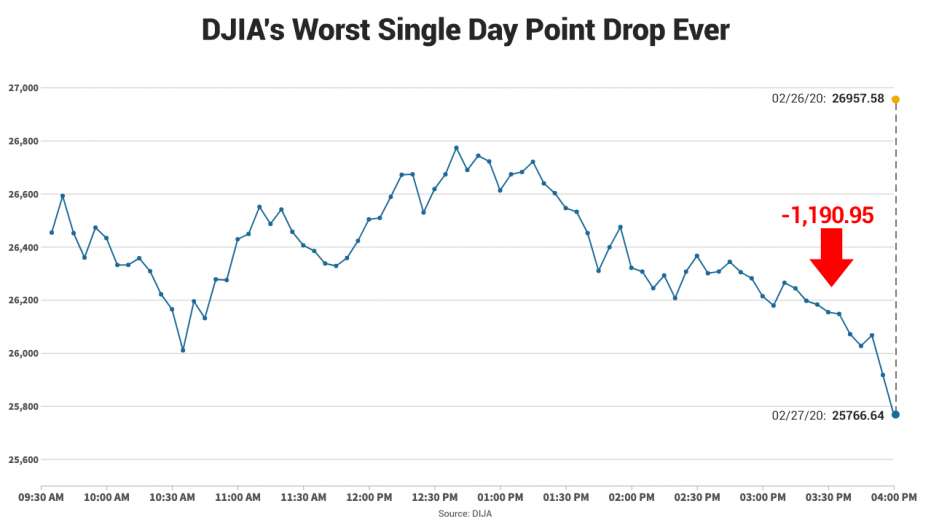
This is not an inappropriate response. As much as I personally dislike the effect it has on everyone’s finances, it makes sense. We are regularly setting of the stock market’s “circuit breaker”. Here’s a breakdown of when that happens via Vanguard’s website:

Level 1 halt (7%)

  • Trading will halt for 15 minutes if drop occurs before 3:25 p.m.
  • At or after 3:25 p.m.—trading shall continue, unless there is a Level 3 halt.

Level 2 halt (13%)

  • Trading will halt for 15 minutes if drop occurs before 3:25 p.m.
  • At or after 3:25 p.m.—trading shall continue, unless there is a Level 3 halt.

Level 3 halt (20%)

  • At any time during the trading day—trading shall halt for the remainder of the trading day.

We’re responding so quickly to the anticipated future that we actually have to have these speed bumps in place to slow things down. (“We” meaning, humans. Not necessarily me or my community in particular. I like to think of us all in the same boat, especially in light of a pandemic.)

This has meant that the value of all of the dividend investments I chose a couple months ago has plummeted. “But wait”, you may interject, “aren’t these dividend paying companies? Shouldn’t the value of the stock NOT be your primary concern, since they were specifically chosen for their regular dividend distributions?” Why, yes dear reader, you are correct.

It’s been a difficult ride emotionally to see the valuations drop, but the dividend is why we came here in the first place. So, how’s the dividend payout been so far? To put it bluntly, it feels a bit like I’m playing an uneventful game of hide-and-go-seek with dividends. Somehow I thought the game would start earlier. And move quicker. And be more exciting. In general, I’ve only gotten a handful of very small dividends.
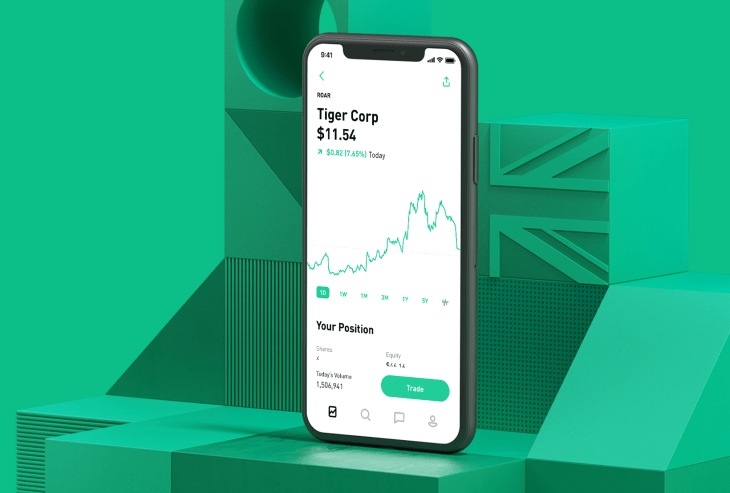
First: The individual companies I chose through Robinhood have paid a total of 4 dividends. They are:

  • XOM: February 10, dividend of $0.87/share X 2 shares= $1.74 total received
  • MMM: February 13, dividend of $1.47/share X 1 share= $1.47 total received
  • WBA: February 18, dividend of $0.46/share X 1 share= $0.46 total received
  • PSEC: February 27, dividend of $0.06/share X 2 shares= $0.12 total received
  • Total= $3.79
  • Total dividend return 0.38%

Robinhood continues to be the simplest, easiest, most intuitive investing platform by far. It is very clear what is happening with each investment you choose and when an upcoming dividend is scheduled. Then once the dividend is paid, it is clearly shown on your summary for that particular stock. Here’s what Walgreens looks like when I scroll to to the bottom of the screen:
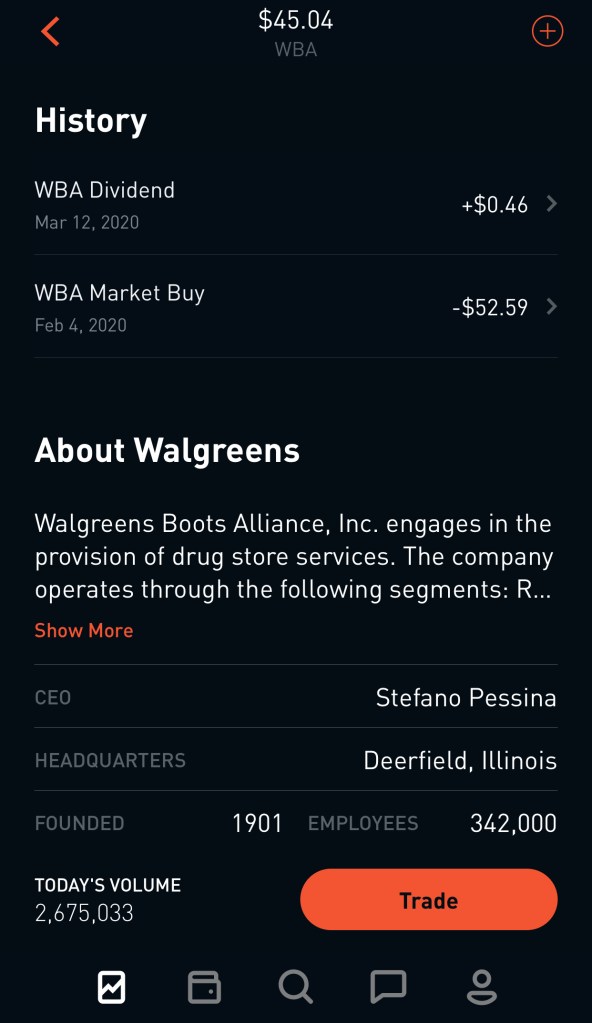
Robinhood app clearly showing dividend amount and date.

The dividends paid so far by these companies have been about on track with my expectations. However, the dividends for the rest of this calendar year should be far less than expected. The negative effects of COVID-19 will likely hit profits hard for all of these companies, with the exception of Walgreens. It may actually benefit financially!

Second: Diversified funds chosen to pay dividends through Webull

If you remember from Part 2 of the $2000 Passive Income Experiment, the goal with these investments was to gain significantly more diversity than the ones chosen with Robinhood. These funds hold many different companies, so the rise or fall of a specific stock is not felt as much. My assumption was that this would prove to be the winner in the long run, but with the outbreak of COVID-19, it feels like there won’t be a winner as much as an investment that loses less!

Thus far, no dividends have been paid from these investments! At time of writing technically the end of the first fiscal quarter has not come, so that may be the point at which many companies and funds normally would pay their first dividend of the year. In any case, I’m not planning to sell these investments any time soon so we should have plenty of time to see what happens in the future.

The dry, empty status of my indexes dividends
Photo by icon0.com on Pexels.com

Also, Webull isn’t as anxious to tell you everything that happens the moment it happens like Robinhood. They are more “old school” when it comes to updates and changes to your account. One of these areas seems to be dividend payouts. Robinhood makes a push notification appear, shows it on the “Messages” tab, and files it on the page of the stock itself (when you view it on your device). So you can’t really miss it. Webull (I trust!) only shows dividend payouts on the monthly statement after it’s happened.

The roller coaster of volatility in recent days and weeks is one of the reasons why dividend investing seems interesting to me. As long as companies still agree to pay their dividend, the price of the index or stock itself sort of doesn’t matter. Thus far the start of this experiment has been slow, but I anticipate it picking up in the near future!


Part 2: $2000 Passive Income Experiment: The Investments

Photo by Artem Beliaikin on Pexels.com

But, Mousie, thou art no thy lane [you aren’t alone]
In proving foresight may be vain:
The best laid schemes o’ mice an’ men
Gang aft a-gley, [often go awry]
An’ lea’e us nought but grief an’ pain,
For promised joy.

-Robert Burns’ poem, To A Mouse, 1786

When starting this experiment I hadn’t even considered the possibility of a stock market correction on the scale of 35%+. Honestly it was a mix of foolish optimism and a lack of experience. For my entire investing lifetime it’s been a bull market. Before 2009 I didn’t have money to invest anyway. Everything was immediately spent! Now that I’m allegedly older and wiser, a significant portion of our combined income goes to investments but I have to admit that this downturn has been an emotional workout!

Enough gloom and doom! Let’s get back to the real content of the experiment at hand!

In this post I’ll outline the specific stocks and funds I chose, why I chose them, and what I anticipate the outcome to be overall.

First: Dividend-paying indexes

Our first group contender is the $1000 invested with Webull into dividend-paying indexes. If you’re not familiar with the concept of an index, here’s a very short explanation. An index is just a group of stocks chosen based on whatever parameters people want, all grouped together into one basket. You buy a portion of the entire basket, getting the benefits of diversifying with all those stocks inside it.

Still feel a little confused? Me too….let’s think about it in terms of pizza!

Photographer Victor Protasio, Food Stylist Rishon Hanners, Prop Stylist Sarah Elizabeth Cleveland

The ingredients of the pizza represent stocks. Flour, water, salt, pepperoni, sausage, tomato, oregano, cheese, olives, onion, etc…. Choosing individual stocks is like just buying the cheese or the salt or a little piece of sausage. If they are really awesome (i.e. increase in value/pay regular dividends) then maybe you’d be happy with just eating them alone. But if you want all of them combined, you would have to go out and buy specific amounts of each to aggregate yourself. That’s a lot of work to find what you want, how much of it you want, and buying it all in pieces.

In contrast, an index is just buying the whole pizza. Its assembled for you with all the right ingredients based on what you ordered. Ah you like the pizza based on the S&P 500? Here you go. Only want the dividends and don’t care about growth, there’s a pizza (index) for you. Whatever your flavor, there’s an index already hot and ready and waiting.

The benefits are that an index is simple, automatically diverse, and readily available. It’s a powerful tool that you can take advantage of now and don’t even need to hire a fancy high-powered financial guru to manage.

“By periodically investing in an index fund, for example, the know-nothing investor can actually outperform most investment professionals. Paradoxically, when ‘dumb’ money acknowledges its limitations, it ceases to be dumb.”

(Warren Buffet, 1993)

I chose a small handful of indexes that are made to follow dividend paying companies. This way I get to take advantage of all of them simultaneously! Here they are:

  • VIG: Vanguard Dividend Appreciation ETF
  • VYM: Vanguard High Dividend Yield ETF
  • JDIV: JPMorgan U.S. Dividend ETF

VIG: Vanguard Dividend Appreciation ETF

Vanguard has always been a go-to investment group for people looking for low fees and great returns. They LITERALLY invented the index fund for this purpose. VIG is a fund that is designed to track another index called the NASDAQ US Dividend Achievers Select Index. That index chooses investments with at least ten consecutive years of increasing annual regular dividend payments. Sounds good to me! On top of that, the expense ratio is a teeny tiny 0.06%! That’s about as close to totally free investing as we are going to get! It holds 186 different stocks and most of them are big names you’ve definitely heard of. Like these:

Month-end 10 largest holdings
(35.50% of total net assets) as of 02/29/2020 

1Microsoft Corp.
2Visa Inc.
3Procter & Gamble Co.
4Walmart Inc.
5Johnson & Johnson
6Comcast Corp.
7McDonald’s Corp.
8Abbott Laboratories
9Medtronic plc
10Costco Wholesale Corp.
Sector
Basic Materials3.6%
Consumer Goods10.6%
Consumer Services20%
Financials11.5%
Health Care11.9%
Industrials26.2%
Technology9.9%
Utilities6.3%

JDIV: JP Morgan U.S. Dividend ETF

I only chose this ETF because I needed to round out the $1000 total and the price was just about right to do that! I did almost no research to choose it besides noticing the famous name (JP Morgan) and the fact that it held over 200 companies. It turns out that it’s a very small ETF with only about $34 million in holdings. Thankfully, it’s well-diversified over a number of sectors and companies! It is also inexpensive to own with a net expense ratio of 0.12%! That means they only charge you $1.20 for every $1000 invested.

JDIV Top 10 Holdings

As of 03/25/2020

SymbolNameSecurity Identifier% of Net AssetsMarket Value
CLXCLOROX CO/THE COMMON1890541090.84%216,351.96
GILDGILEAD SCIENCES INC3755581030.82%211,836.06
DLRDIGITAL REALTY TRUST INC2538681030.82%210,802.48
CYCYPRESS SEMICONDUCTOR2328061090.80%206,885.00
LLYELI LILLY & CO COMMON5324571080.80%205,346.96
AMGNAMGEN INC COMMON STOCK0311621000.79%202,410.72
INTCINTEL CORP COMMON STOCK4581401000.78%201,861.88
VZVERIZON COMMUNICATIONS92343V1040.78%200,209.46
JNJJOHNSON & COMMON4781601040.77%199,278.60
GISGENERAL MILLS INC COMMON3703341040.77%197,271.00

Sector Exposure

As of 03/25/2020

SectorFUND
Basic Materials 9.5%
Consumer Goods 15.1%
Consumer Services 7.9%
Financials 16.4%
Health Care 7.6%
Industrials 9.5%
Oil & Gas 5.5%
Other 0.0%
Technology 6.4%
Telecommunications 3.7%
Utilities 18.9%

VYM: Vanguard High Dividend Yield ETF

VYM is yet another index that’s made to track some other index. It is designed to track the FTSE High Dividend Yield Index. Unlike the FTSE index it is made up of domestic stocks, but holds a very similar ethos of only holding dividend-paying companies. Like the others, it’s made up of many different companies so all of your eggs aren’t trusting the same proverbial basket. For example, at the end of February the top holding was a tie between JPMorgan Chase & Co and Johnson & Johnson at 3.80%. So even if Chase absolutely plummeted, it’s less than 4% of the whole. The 10 largest holdings in the index make up less than 27% of the total, which gives you an idea of how small each piece of the pie really is. I view this as a good thing. Yes, it’s less likely to have a rocket ship company make me a millionaire overnight, but that also means it’s likely to handle the market downturns better as well.

If you care to compare, there’s the break-down of the different sectors of companies in this index fund:

Portfolio composition

Equity sector diversification

SectorHigh Dividend Yield ETF
as of 02/29/2020
FTSE High Dividend Yield Index (Benchmark)
as of 02/29/2020
Basic Materials3.30%3.30%
Consumer Goods14.40%14.40%
Consumer Services9.20%9.10%
Financials18.30%18.30%
Healthcare14.10%14.10%
Industrials8.30%8.30%
Oil & Gas7.10%7.20%
Technology10.60%10.50%
Telecommunications5.20%5.20%
Utilities9.50%9.60%

Whew! Lots of numbers. Just a few more: About 98% of this part of the investments are in the 2 Vanguard funds, with a tiny bit of that oddball JDIV bringing up the last 2%. The point of this exercise is to test how easy it is to just pick 1-2 (or in my case 3 just to round out an even $1k) indexes and “set it and forget it”.

Second: Picking specific companies that pay dividends.

Photo by Andrea Piacquadio on Pexels.com

This is what it feels like to me when anyone picks an individual company. Or even a handful of individual companies. I’m FAR from a financial analysis guru, but even people who make a successful career from analyzing companies financial standing can’t accurately and reliably pick winners. The fact that the pro’s lose to “the market” as a whole over 95% of the time makes me realize how small of a chance I actually have to do that kind of thing.

For the purposes of this experiment I picked dividend paying companies that the Interwebs claim are worth considering. Once you type things like “dividend stocks” and “passive dividend investing” into Google, you get a lot of very direct advise (and a lot of people wanting to sell you their opinion) on where to invest your hard earned money.

A lot of people claim the “Dividend Aristocrats” are a sure-fire way to succeed. So I considered those. Others have hot picks based on the current state of the market, of consumer sentiment, of perceived demand, or any other number of factors. Knowing that the pros don’t generally taste success with a TON of smart analysis made me feel like I was partially off the hook when it came to pouring over prospectus statements and P/E ratios and all the other paperwork available. I went with what made sense at the time and didn’t look back.

SO, who did I choose. These lovely companies:

  • F: Ford
  • ABBV: AbbVie
  • AOS: A.O. Smith
  • MMM: 3M
  • PBCT: People’s United Bank
  • WBA: Walgreens
  • XOM: Exxon Mobile
  • T: AT&T
  • PSEC: Prospect Capital

The only company that I didn’t choose strictly on the recommendations of logic and anonymous internet brethren was Ford. I like their vehicles. I’ve also wanted to invest in them since 2010, and have regretted not since at the time the stock was only $2.00/share. It’s risen a lot since then and has paid dividends along the way.

You’ve likely heard of a handful of these companies and have an idea of what they do. I’d never heard of PBCT or PSEC. People’s United Bank is a bank and financial holding company doing….bank sounding stuff. (Insert shrug emoji here!) And Prospect Capital is a business development company that basically lends money to companies or invests in them directly. Anyway, enough about them.

In next week’s post I’ll share how the results have fared thus far. Fair warning: it is NOT pretty.

$2000 “Passive Income” experiment

Everyone loves the sound of earning money without having to spend any time or effort! What’s NOT to love?

Photo by Rebeca G Souza on Pexels.com

Lately there has been a massive uptick in the popularity of “passive income” related content and strategies. Of course the concept is intriguing but it should be met with healthy amounts of questions and skepticism.

  • If passive income is so easy, why don’t more people take advantage of it?
  • If we can “make money while you sleep”, shouldn’t everyone be doing this?
  • How realistic are the claims being made by these smooth talking, promise-slinging geniuses of all things money?
  • Is this the way rich people became rich?

If you pay attention and listen between the alluring and ever-hopeful promises of the passive income gurus you may begin to realize that this income isn’t quite as passive as the name implies. Generally people either need large sums of money to generate regular income and/or it takes additional work to generate this income. So…not really passive at all. Quite active actually.

Earning the money needed to investment is active. And a side job called “real estate rental property” is far from passive. Other options include selling a product online, making an online course, selling stock photography, affiliate marketing, YouTube ad revenue, peer to peer lending, vending machines, drop shipping, renting items you already own, crowdfunded real estate, and the list goes on. Do you see the common theme? Startup money + hard work= the possibility of income. To me, that’s just the bones of starting a business.

Startup money + hard work= the possibility of income. To me, that’s just the bones of starting a business.

-truth hurts

So what is actually passive?

If income is to be TRULY passive it needs to require ZERO time or effort on your part. If you want to input extra time to monitor your progress or contribute work to potentially add value, that’s optional. In my mind the best and most passive sources of income have to be from the stock market.

The stock market is a complex, moody beast of a thing but we can choose to make it more or less so. Indexed funds allow us to invest in a low cost and automatically well diversified group of companies or funds without having to get an MBA or understanding a business prospectus statement. But there are people who still love to pick their own stocks and insist they are successful at choosing the ones that net them great passive income.

The experiment:

So to save you the headache and to satisfy my own curiosity I am going to invest in both ways: indexed funds and individual stocks. Not only that, I am choosing to invest specifically in companies and funds that have a track record of paying regular dividends to their investors.

Dividends are a portion of the profit made by the company that they choose to send to their investors. Generally companies that choose to pay dividends make this a regular occurrence. The most common schedule is quarterly payments, but that can vary wildly.

People like to recommend their own way of thinking when it comes to picking “good” stocks. They decide by reading about the company, looking at financial statements, mimicking other investors, or my personal “favorite”: if you “know the product and like it”. PLEASE read into the sarcasm here. That’s my “favorite” strategy because its so completely silly. Whether or not a company makes a product you personally like as 1 lowly consumer really has ZERO bearing on whether it’s a worthwhile investment. (Yes Apple, Tesla, Netflix, Facebook, and others have skyrocketed in value. And yes if you’d invested in them early on that would have been great. But for those of us who are getting started investing and don’t want the kind of risk associated with one stock rising and falling in value, there are other options)

In contrast to this method of choosing companies 1-by-1 I will also be investing in a number of funds that are a massive variety of companies that have a great record of paying their investors regular dividends. The benefit of these kinds of funds over a single company is that they are spreading your money over dozens or hundreds of companies. So if a few losers don’t pay a dividend this quarter, have a terrible year, or go out of business, it doesn’t hurt very badly. In contrast, if you’re expertly chosen gamble on that one company you think is “cool” happens to not work out, there goes your whole investment.

You can probably accomplish your entire goal of a relatively safe and good performing dividend investment with just 1 fund. However, in an effort to be as diverse as possible to prove the point, I will invest in several different funds full of dividend paying companies.

These 2 strategies will likely have some overlap since the handful of companies I pick will likely be included in the big funds in the other half of the investment experiment. So it’s not meant to single them out as good or bad or to judge my ability to pick a winner. It’s more to show the possible swings in performance and risk you accept when picking a small number of companies vs letting a fund do that work for you.

The 2 $1000 bets:

To complete this experiment I am using $2000 total. $1000 will go into the handful of individual stocks that are picked based on popular opinion and their track record for paying dividends reliably in the past. The other $1000 will be invested in a small number of dividend index funds. That’s it. They get to sit and stew and we will watch the rise and fall of their value as well as the actual amount of “passive income” that is generated by each account.

Contender #1: Robinhood

For the individual stock account I am using Robinhood. It is a tremendously popular app for people to use when getting started investing and is geared toward picking individual stocks and monitoring them closely.

You now have a claim to a stock like Apple, Ford, or Facebook. In order to keep this claim to your stock, sign up and join Robinhood using my link.

Contender #2: Webull

For the diversified index funds of companies I am using Webull. Webull is not nearly as popular as Robinhood but gives the user a TON of information about their investments. Far more than I ever want or need. But it’s impressive and if you’re wanting that kind of depth in your investment monitoring, Webull is the app for you. It also has a browser-based dashboard that shows a wealth of live updating detail and is guaranteed to help you feel like a stock broker in a movie scene!

Get 2 free stocks when you open and fund your account with Webull through my link:

For a more complete breakdown on what investing services I recommend and why, check out my investing page here!

Stay tuned for updates as the dividends roll in! I will post the breakdown of companies and funds as well as the exact dividends they paid!


Disclaimer: I am not a certified financial planner and hold no formal education or training in the field of investing or personal finances. Any and all information on this site is for entertainment purposes only and is not necessarily applicable to the reader’s personal situation and circumstances.