The simplest “diet” you’ve never heard of. Mine.

Every year there is a new trend in human nutrition. Depending on the objective, the swings in prescribed methods of fueling your body can be drastic.

Chocolate is good. Chocolate is bad.

Coffee is good. Coffee is bad.

Alcohol is bad. Alcohol is good.

Fat is bad. Fat is good.

Carbs are bad. Carbs are good.

On and on and on. Turning in circles. It feels like we are lost, without a map, wandering around a landscape of endless options and opinions.

But what is the destination of this journey? General healthiness, right? I mean some of us are wanting slightly different outcomes from our eating practices than others, but largely we just desire a healthy body, at a healthy weight, with a healthy proportion of muscle and fat. Barring any specific dietary needs or restrictions from allergies, medical conditions, or religious purposes, that “SHOULD” narrow things down overall.

This was my logic and still is. And in the setting of the modern, western world the path to take with that destination in mind should be fairly straight. Here’s what it is!

  1. Eat as much “real food” as possible. (I.e. as little commercial processing as possible.)
  2. Eat less sugar
  3. Eat less fried food
  4. Otherwise, moderation.

That’s it!

So how did this perspective come about? Bodybuilding! Yes, seriously. Stick with me here. When I was a freshman in high school, I had an emotionally damaging experience. Nothing objectively horrible, but it shamed me enough to put a chip on my shoulder.

I was forgotten by my coach during a sports award ceremony. Then when my teammates reminded him of this oversight, he hastily called me up to stand with the rest of the team and tried to cobble together a few words about my participation and performance over the past season. The line that was burned into my mind like a branding iron was: “…once his strength develops….”.

This was alluding to a lack of ability on my part and the expectation that developing more strength in the future would improve. Not only is this a potentially damaging comment to make about a young man in front of a room full of peers, coaches, parents, and administrators, but the sport in question was GOLF!

GOLF!

A game that demands very little relative strength! GOLF!

The chip on my shoulder was more like a chunk. I was furious, ashamed, belittled, and determined to make sure that never happened again. Every night before getting in the shower I would do as many push-ups as I could. Then before going to bed I would do dumbbell curls until I couldn’t lift the weight any longer. (Typical teenage boy workouts, ha!)

My sister played basketball for the same high school and during their practices the coach would sometimes bring them into the weight room to workout. Since I depended on her for a ride home after school, I was stuck there but now had occasional access to the weight room. I had no idea what I was doing, but dawdled around and did my best to make my little muscles grow and avoid more shame.

When my sophomore year rolled around and I was allowed to enroll in “Weight Training” as an elective, I jumped all over it. It was a relaxed class atmosphere with very little instruction and oversight compared to a normal class. Our grades only depended on our 1-rep max weight increasing over the course of the semester. How we got there and spent the time between “tests” was entirely up to us. I devoured the little information our teacher provided and supplemented it with grocery store muscle magazines.

“How to increase your bench press.”

“How to grow your arms.”

“How to get giant quads.”

“How to build your lats.”

All of the information was flooding into my brain and I was absorbing it all like a thirsty sponge. The next 2 years of high school also included Weight Training class and I was as diligent as anyone in the school with my training. Chest workouts one day. Leg workouts another. An entire day dedicated to arms (of course). Another day spent learning to power clean with better form. And on and on.

The muscle did slowly accumulate over my lanky frame. When the comment was made during that sports award ceremony I didn’t think my strength was lacking. Apparently I was wrong. Now that I had been training for over 3 years, I was much stronger and yet still somehow fully convinced that the deficiency remained. The deficiency that likely wasn’t even there to begin with.

I was 6’4″ tall, weighing a lean 194 lbs despite eating nearly everything in sight. Between weight training, varsity soccer, and varsity track, my body was burning calories at an absurd rate. My 1-rep maxes were deep into “respectable” territory for an 18 year old amateur. I could bench 235, squat 335, and clean 255. Enough to put me toward the top of the class overall. I ran a 4.65 40-yard dash over and over, which was the fastest in the entire school. I was the fastest sprinter on the track team and went on to win the boys 4A State Track and Field title in the 200m, setting a new school record. I also helped to set school records in the 4x100m and 4x400m relays. On top of that, my classmates voted me as “Best Physique” in the senior class, which was immortalized in the yearbook.

Every indicator of success was mine. The story had been overturned. I had irrefutable proof that I was strong enough, fast enough, GOOD ENOUGH. But possibly the last person still holding onto that old belief that my strength had yet to develop was me. That my worth was yet to develop. That adequate reason to remember me was not present. The chip on my shoulder remained.

Once into college my working out intensified. The new environment of a college campus and all of the new people to make a first impression on stoked the fire of my insecurity. I worked out every weekday for between 2 and 4 hours. Heavy weight training, arduous ab workouts, outdoor sprints, and everything in between filled my afternoon schedules.

I was a regular at a nearby community college and befriended an exercise science professor who also worked in their fitness center part time. In fact the fitness center staff was entirely made up of faculty. It was an amazing wealth of knowledge and experience and was the single biggest factor shaping my training, diet, and recovery both then and now. My results continued to accumulate and my sense of self worth continued to…not continue. It stagnated.

Part of my drive to be exceptional physically was to adopt the dietary habits needed to foster the results I was seeking. Obviously a lot of the advertising in the fitness industry is paid for by supplement companies. But man cannot live on protein shakes alone. Or on just chicken, brown rice and broccoli. I needed to foster fat loss, muscle gain, and peak performance without a mentally taxing list of restrictions or a fancy meal plan.

Out of that mentally unhealthy time came a simple and easy to follow guideline for eating. I hate the word “diet” and its connotations so we will avoid it. Guidelines are something you choose with a sober mind and follow because they result in logical and sustainable outcomes. The guidelines at that time were:

  1. No sugar
  2. No fried foods. (except tortilla chips, which are impossible to refuse)
  3. Eat lots of protein

That’s it. Still a good guideline system overall in my opinion, but not as sustainable or as balanced as the 4-Steps above. Notice the change here to completely abstaining from both sugar and fried foods. This along with my propensity for treating workouts like a part time job lead to a ridiculously low body fat percentage of about 4%. They tested it there at that professor-rich community college and I was advised to stop losing body fat because I was at the limit of what is healthy to maintain. Any less body fat and I would be taking steps in the wrong direction. I ate so little sugar that when I visited the dentist they said, “Wow! What do you eat?”. There was so much less decay happening in my teeth than their average patient that it was immediately noticeable.

But abstaining from a whole chunk of available foods is really difficult in the long-term. A little birthday cake or a chicken biscuit won’t throw off your training, progress, or healthy to any measurable degree. So we will switch from “No” to “Less”.

Eat as much “real food” as possible. (I.e. as little commercial processing as possible.)

This guideline came about in 2020 (this year) when I was looking for a single rule I could consider when choosing what to put in my stomach. A simple thought to run through your mind that considers your overall health without the oppression of other voices that are largely driven by shame, guilt, or other damaging motivations. The chip on my shoulder should not be allowed to dictate my life any more.

Eat less sugar

This is probably predictable. But it’s still true. Sugar seems to be in everything that is fast and tasty. Its negative effects are largely known and are commonly understood. It’s still something that is very tempting and very easy to go ahead and give in to. A little flavored coffee creamer, one of those good pastries, a bit of candy before lunch, a fruit smoothie, a little treat in the afternoon, and a scoop of ice cream for dessert is not an uncommon day of dietary indulgences. But if you add up the total amount of unnecessary sugar intake from those little delicious treats, it is ridiculous.

Eat less fried food

Frying food makes it more delicious. One of the universal truths. However, the salty fatty crispy coating also makes it detrimental to your health. Probably. Much of the time I find the food that is being fried is actually so lacking in nutrition or desirability that it’s only through frying that it is able to hold any appeal. Mm-mm potato strips. Not very tasty. French fries: delicious.

Otherwise, moderation.

Always a good idea to take things in moderation. Even if something seems to be really healthy, consuming an obscene quantity can cause detrimental effects. We aren’t made to only consume fruits or only consume meats or whatever the suggested monochromatic trend prescribes. Odds are we need to consume a different ratio of veggies, fruits, carbs, and meats than we currently do, but even then having some of each is likely the healthiest overall choice. Obviously moderating the amount of blatantly unhealthy foods and drinks is wise. But that is often the hardest category in which to exercise self discipline. If a bite of pie is good, then 3 pieces of pie is really good!

One of the most immediately successful habits I have experimented with in my own pursuit of self control and moderation is speed. Just slowing down to consider what is happening can snap you back into reality. Labeling the activity helps bring to light the goodness of the situation and can bring some clarity. “I am in my own home, with people I care about, getting to eat this delicious food. How amazing is this! What a treat! I GET to have this dinner, this dessert, this snazzy cocktail. Wow, this is a privilege.” It is when I am most mindless and emotional that my indulgences run wild and I finish that bag of chips or that pint of ice cream.

Getting results is fun. Getting to the goal weight/size/performance/aesthetic is an achievement for sure. But sacrificing your sense of self worth or sanity is NOT WORTH IT.

-Brendan

Getting results is fun. Getting to the goal weight/size/performance/aesthetic is an achievement for sure. But sacrificing your sense of self worth or sanity is NOT WORTH IT.

The toll this takes on your mental and spiritual health isn’t covered by any physical satisfaction gained along the way. You have to be a whole person. Satisfied, sane, and safe. Telling yourself you aren’t enough, aren’t ok, aren’t who you need to be and letting that be a non-stop recording in your own head is not the way.

The chip on my shoulder has mostly healed. I’m not sure it can ever fully heal. But today, I want to be healthy so I can experience life fully. I can indulge in a brisk run when the weather is good and enjoy the speed my legs still have. I can chase my nieces around for an hour without getting so tired I have to quit. I can help people near me who are not as strong to move heavy things. (This sounds simple and silly, but it actually is a regular occurrence!)

I can have fun setting a fitness goal and working towards it for the thrill of the chase, the development of discipline, and the fun of sharing the journey, without it determining my self worth.

This is the kind of structure we need around our food intake. One that takes into account the bigger goals in life and is both motivating and simple enough to be something we can do for years or decades to come. One that we can talk openly about without feeling ashamed. One that encourages all forms of health, and doesn’t trade physical health for mental health.

Happy Eating!

Part 3: $2000 Passive Income Experiment

Starting at the worst possible time to invest: literally.

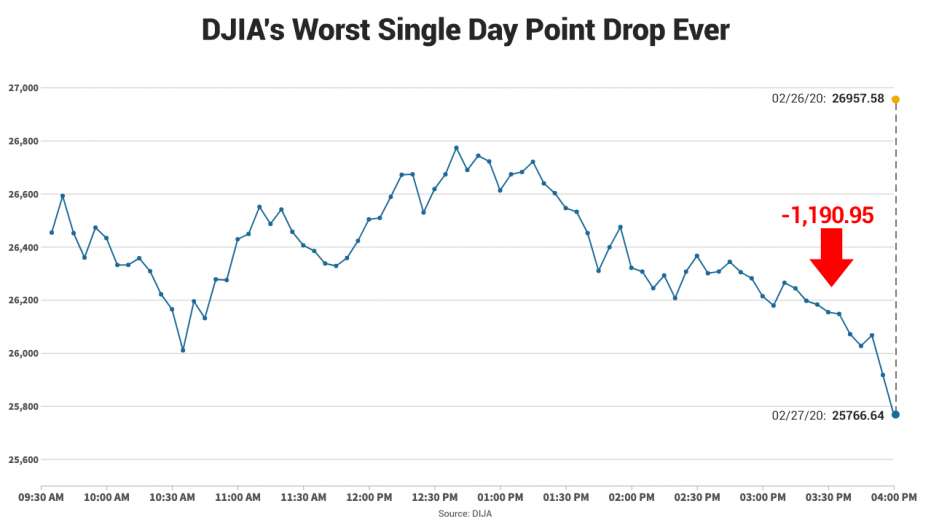
When I wrote Part 1 of the $2000 Passive Income Experiment, the stock market was booming along with virtually every other market. Not long after, Part 2 of the $2000 Passive Income Experiment laid out what indexes and companies I am investing in. At that time public sentiment was positive and cash was flowing. Almost immediately afterward, things changed drastically. Global infection rates of COVID-19 became topic of public conversation and a resulting stock sell-off began.

SARS-CoV-2

Besides generally being afraid for their own health and wellness along with the health of loved ones, the accompanying sentiment is that people will need to be quarantined and thus, not spending money like they normally do. This of course is true, is happening, and the effects are easily visible in the market. Profits have dropped, valuations have dropped, and general business outlook has dropped.

This is not an inappropriate response. As much as I personally dislike the effect it has on everyone’s finances, it makes sense. We are regularly setting of the stock market’s “circuit breaker”. Here’s a breakdown of when that happens via Vanguard’s website:

Level 1 halt (7%)

  • Trading will halt for 15 minutes if drop occurs before 3:25 p.m.
  • At or after 3:25 p.m.—trading shall continue, unless there is a Level 3 halt.

Level 2 halt (13%)

  • Trading will halt for 15 minutes if drop occurs before 3:25 p.m.
  • At or after 3:25 p.m.—trading shall continue, unless there is a Level 3 halt.

Level 3 halt (20%)

  • At any time during the trading day—trading shall halt for the remainder of the trading day.

We’re responding so quickly to the anticipated future that we actually have to have these speed bumps in place to slow things down. (“We” meaning, humans. Not necessarily me or my community in particular. I like to think of us all in the same boat, especially in light of a pandemic.)

This has meant that the value of all of the dividend investments I chose a couple months ago has plummeted. “But wait”, you may interject, “aren’t these dividend paying companies? Shouldn’t the value of the stock NOT be your primary concern, since they were specifically chosen for their regular dividend distributions?” Why, yes dear reader, you are correct.

It’s been a difficult ride emotionally to see the valuations drop, but the dividend is why we came here in the first place. So, how’s the dividend payout been so far? To put it bluntly, it feels a bit like I’m playing an uneventful game of hide-and-go-seek with dividends. Somehow I thought the game would start earlier. And move quicker. And be more exciting. In general, I’ve only gotten a handful of very small dividends.

First: The individual companies I chose through Robinhood have paid a total of 4 dividends. They are:

  • XOM: February 10, dividend of $0.87/share X 2 shares= $1.74 total received
  • MMM: February 13, dividend of $1.47/share X 1 share= $1.47 total received
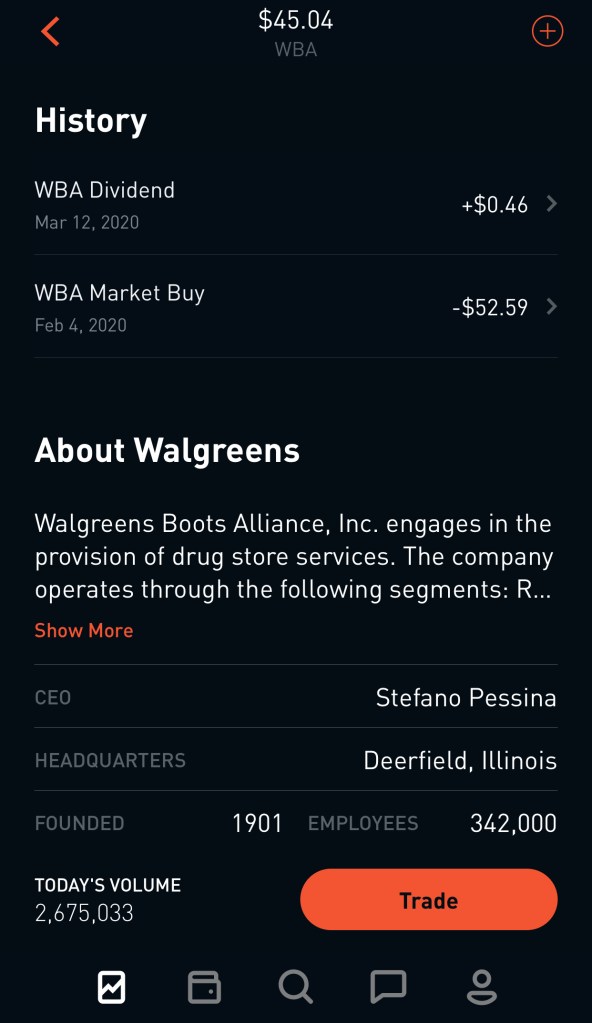
  • WBA: February 18, dividend of $0.46/share X 1 share= $0.46 total received
  • PSEC: February 27, dividend of $0.06/share X 2 shares= $0.12 total received
  • Total= $3.79
  • Total dividend return 0.38%

Robinhood continues to be the simplest, easiest, most intuitive investing platform by far. It is very clear what is happening with each investment you choose and when an upcoming dividend is scheduled. Then once the dividend is paid, it is clearly shown on your summary for that particular stock. Here’s what Walgreens looks like when I scroll to to the bottom of the screen:

Robinhood app clearly showing dividend amount and date.

The dividends paid so far by these companies have been about on track with my expectations. However, the dividends for the rest of this calendar year should be far less than expected. The negative effects of COVID-19 will likely hit profits hard for all of these companies, with the exception of Walgreens. It may actually benefit financially!

Second: Diversified funds chosen to pay dividends through Webull

If you remember from Part 2 of the $2000 Passive Income Experiment, the goal with these investments was to gain significantly more diversity than the ones chosen with Robinhood. These funds hold many different companies, so the rise or fall of a specific stock is not felt as much. My assumption was that this would prove to be the winner in the long run, but with the outbreak of COVID-19, it feels like there won’t be a winner as much as an investment that loses less!

Thus far, no dividends have been paid from these investments! At time of writing technically the end of the first fiscal quarter has not come, so that may be the point at which many companies and funds normally would pay their first dividend of the year. In any case, I’m not planning to sell these investments any time soon so we should have plenty of time to see what happens in the future.

The dry, empty status of my indexes dividends
Photo by icon0.com on Pexels.com

Also, Webull isn’t as anxious to tell you everything that happens the moment it happens like Robinhood. They are more “old school” when it comes to updates and changes to your account. One of these areas seems to be dividend payouts. Robinhood makes a push notification appear, shows it on the “Messages” tab, and files it on the page of the stock itself (when you view it on your device). So you can’t really miss it. Webull (I trust!) only shows dividend payouts on the monthly statement after it’s happened.

The roller coaster of volatility in recent days and weeks is one of the reasons why dividend investing seems interesting to me. As long as companies still agree to pay their dividend, the price of the index or stock itself sort of doesn’t matter. Thus far the start of this experiment has been slow, but I anticipate it picking up in the near future!

Part 2: $2000 Passive Income Experiment: The Investments

Photo by Artem Beliaikin on Pexels.com

But, Mousie, thou art no thy lane [you aren’t alone]
In proving foresight may be vain:
The best laid schemes o’ mice an’ men
Gang aft a-gley, [often go awry]
An’ lea’e us nought but grief an’ pain,
For promised joy.

-Robert Burns’ poem, To A Mouse, 1786

When starting this experiment I hadn’t even considered the possibility of a stock market correction on the scale of 35%+. Honestly it was a mix of foolish optimism and a lack of experience. For my entire investing lifetime it’s been a bull market. Before 2009 I didn’t have money to invest anyway. Everything was immediately spent! Now that I’m allegedly older and wiser, a significant portion of our combined income goes to investments but I have to admit that this downturn has been an emotional workout!

Enough gloom and doom! Let’s get back to the real content of the experiment at hand!

In this post I’ll outline the specific stocks and funds I chose, why I chose them, and what I anticipate the outcome to be overall.

First: Dividend-paying indexes

Our first group contender is the $1000 invested with Webull into dividend-paying indexes. If you’re not familiar with the concept of an index, here’s a very short explanation. An index is just a group of stocks chosen based on whatever parameters people want, all grouped together into one basket. You buy a portion of the entire basket, getting the benefits of diversifying with all those stocks inside it.

Still feel a little confused? Me too….let’s think about it in terms of pizza!

Photographer Victor Protasio, Food Stylist Rishon Hanners, Prop Stylist Sarah Elizabeth Cleveland

The ingredients of the pizza represent stocks. Flour, water, salt, pepperoni, sausage, tomato, oregano, cheese, olives, onion, etc…. Choosing individual stocks is like just buying the cheese or the salt or a little piece of sausage. If they are really awesome (i.e. increase in value/pay regular dividends) then maybe you’d be happy with just eating them alone. But if you want all of them combined, you would have to go out and buy specific amounts of each to aggregate yourself. That’s a lot of work to find what you want, how much of it you want, and buying it all in pieces.

In contrast, an index is just buying the whole pizza. Its assembled for you with all the right ingredients based on what you ordered. Ah you like the pizza based on the S&P 500? Here you go. Only want the dividends and don’t care about growth, there’s a pizza (index) for you. Whatever your flavor, there’s an index already hot and ready and waiting.

The benefits are that an index is simple, automatically diverse, and readily available. It’s a powerful tool that you can take advantage of now and don’t even need to hire a fancy high-powered financial guru to manage.

“By periodically investing in an index fund, for example, the know-nothing investor can actually outperform most investment professionals. Paradoxically, when ‘dumb’ money acknowledges its limitations, it ceases to be dumb.”

(Warren Buffet, 1993)

I chose a small handful of indexes that are made to follow dividend paying companies. This way I get to take advantage of all of them simultaneously! Here they are:

  • VIG: Vanguard Dividend Appreciation ETF
  • VYM: Vanguard High Dividend Yield ETF
  • JDIV: JPMorgan U.S. Dividend ETF

VIG: Vanguard Dividend Appreciation ETF

Vanguard has always been a go-to investment group for people looking for low fees and great returns. They LITERALLY invented the index fund for this purpose. VIG is a fund that is designed to track another index called the NASDAQ US Dividend Achievers Select Index. That index chooses investments with at least ten consecutive years of increasing annual regular dividend payments. Sounds good to me! On top of that, the expense ratio is a teeny tiny 0.06%! That’s about as close to totally free investing as we are going to get! It holds 186 different stocks and most of them are big names you’ve definitely heard of. Like these:

Month-end 10 largest holdings
(35.50% of total net assets) as of 02/29/2020 

1Microsoft Corp.
2Visa Inc.
3Procter & Gamble Co.
4Walmart Inc.
5Johnson & Johnson
6Comcast Corp.
7McDonald’s Corp.
8Abbott Laboratories
9Medtronic plc
10Costco Wholesale Corp.
Sector
Basic Materials3.6%
Consumer Goods10.6%
Consumer Services20%
Financials11.5%
Health Care11.9%
Industrials26.2%
Technology9.9%
Utilities6.3%

JDIV: JP Morgan U.S. Dividend ETF

I only chose this ETF because I needed to round out the $1000 total and the price was just about right to do that! I did almost no research to choose it besides noticing the famous name (JP Morgan) and the fact that it held over 200 companies. It turns out that it’s a very small ETF with only about $34 million in holdings. Thankfully, it’s well-diversified over a number of sectors and companies! It is also inexpensive to own with a net expense ratio of 0.12%! That means they only charge you $1.20 for every $1000 invested.

JDIV Top 10 Holdings

As of 03/25/2020

SymbolNameSecurity Identifier% of Net AssetsMarket Value
CLXCLOROX CO/THE COMMON1890541090.84%216,351.96
GILDGILEAD SCIENCES INC3755581030.82%211,836.06
DLRDIGITAL REALTY TRUST INC2538681030.82%210,802.48
CYCYPRESS SEMICONDUCTOR2328061090.80%206,885.00
LLYELI LILLY & CO COMMON5324571080.80%205,346.96
AMGNAMGEN INC COMMON STOCK0311621000.79%202,410.72
INTCINTEL CORP COMMON STOCK4581401000.78%201,861.88
VZVERIZON COMMUNICATIONS92343V1040.78%200,209.46
JNJJOHNSON & COMMON4781601040.77%199,278.60
GISGENERAL MILLS INC COMMON3703341040.77%197,271.00

Sector Exposure

As of 03/25/2020

SectorFUND
Basic Materials 9.5%
Consumer Goods 15.1%
Consumer Services 7.9%
Financials 16.4%
Health Care 7.6%
Industrials 9.5%
Oil & Gas 5.5%
Other 0.0%
Technology 6.4%
Telecommunications 3.7%
Utilities 18.9%

VYM: Vanguard High Dividend Yield ETF

VYM is yet another index that’s made to track some other index. It is designed to track the FTSE High Dividend Yield Index. Unlike the FTSE index it is made up of domestic stocks, but holds a very similar ethos of only holding dividend-paying companies. Like the others, it’s made up of many different companies so all of your eggs aren’t trusting the same proverbial basket. For example, at the end of February the top holding was a tie between JPMorgan Chase & Co and Johnson & Johnson at 3.80%. So even if Chase absolutely plummeted, it’s less than 4% of the whole. The 10 largest holdings in the index make up less than 27% of the total, which gives you an idea of how small each piece of the pie really is. I view this as a good thing. Yes, it’s less likely to have a rocket ship company make me a millionaire overnight, but that also means it’s likely to handle the market downturns better as well.

If you care to compare, there’s the break-down of the different sectors of companies in this index fund:

Portfolio composition

Equity sector diversification

SectorHigh Dividend Yield ETF
as of 02/29/2020
FTSE High Dividend Yield Index (Benchmark)
as of 02/29/2020
Basic Materials3.30%3.30%
Consumer Goods14.40%14.40%
Consumer Services9.20%9.10%
Financials18.30%18.30%
Healthcare14.10%14.10%
Industrials8.30%8.30%
Oil & Gas7.10%7.20%
Technology10.60%10.50%
Telecommunications5.20%5.20%
Utilities9.50%9.60%

Whew! Lots of numbers. Just a few more: About 98% of this part of the investments are in the 2 Vanguard funds, with a tiny bit of that oddball JDIV bringing up the last 2%. The point of this exercise is to test how easy it is to just pick 1-2 (or in my case 3 just to round out an even $1k) indexes and “set it and forget it”.

Second: Picking specific companies that pay dividends.

Photo by Andrea Piacquadio on Pexels.com

This is what it feels like to me when anyone picks an individual company. Or even a handful of individual companies. I’m FAR from a financial analysis guru, but even people who make a successful career from analyzing companies financial standing can’t accurately and reliably pick winners. The fact that the pro’s lose to “the market” as a whole over 95% of the time makes me realize how small of a chance I actually have to do that kind of thing.

For the purposes of this experiment I picked dividend paying companies that the Interwebs claim are worth considering. Once you type things like “dividend stocks” and “passive dividend investing” into Google, you get a lot of very direct advise (and a lot of people wanting to sell you their opinion) on where to invest your hard earned money.

A lot of people claim the “Dividend Aristocrats” are a sure-fire way to succeed. So I considered those. Others have hot picks based on the current state of the market, of consumer sentiment, of perceived demand, or any other number of factors. Knowing that the pros don’t generally taste success with a TON of smart analysis made me feel like I was partially off the hook when it came to pouring over prospectus statements and P/E ratios and all the other paperwork available. I went with what made sense at the time and didn’t look back.

SO, who did I choose. These lovely companies:

  • F: Ford
  • ABBV: AbbVie
  • AOS: A.O. Smith
  • MMM: 3M
  • PBCT: People’s United Bank
  • WBA: Walgreens
  • XOM: Exxon Mobile
  • T: AT&T
  • PSEC: Prospect Capital

The only company that I didn’t choose strictly on the recommendations of logic and anonymous internet brethren was Ford. I like their vehicles. I’ve also wanted to invest in them since 2010, and have regretted not since at the time the stock was only $2.00/share. It’s risen a lot since then and has paid dividends along the way.

You’ve likely heard of a handful of these companies and have an idea of what they do. I’d never heard of PBCT or PSEC. People’s United Bank is a bank and financial holding company doing….bank sounding stuff. (Insert shrug emoji here!) And Prospect Capital is a business development company that basically lends money to companies or invests in them directly. Anyway, enough about them.

In next week’s post I’ll share how the results have fared thus far. Fair warning: it is NOT pretty.

$2000 “Passive Income” experiment

Everyone loves the sound of earning money without having to spend any time or effort! What’s NOT to love?

Photo by Rebeca G Souza on Pexels.com

Lately there has been a massive uptick in the popularity of “passive income” related content and strategies. Of course the concept is intriguing but it should be met with healthy amounts of questions and skepticism.

  • If passive income is so easy, why don’t more people take advantage of it?
  • If we can “make money while you sleep”, shouldn’t everyone be doing this?
  • How realistic are the claims being made by these smooth talking, promise-slinging geniuses of all things money?
  • Is this the way rich people became rich?

If you pay attention and listen between the alluring and ever-hopeful promises of the passive income gurus you may begin to realize that this income isn’t quite as passive as the name implies. Generally people either need large sums of money to generate regular income and/or it takes additional work to generate this income. So…not really passive at all. Quite active actually.

Earning the money needed to investment is active. And a side job called “real estate rental property” is far from passive. Other options include selling a product online, making an online course, selling stock photography, affiliate marketing, YouTube ad revenue, peer to peer lending, vending machines, drop shipping, renting items you already own, crowdfunded real estate, and the list goes on. Do you see the common theme? Startup money + hard work= the possibility of income. To me, that’s just the bones of starting a business.

Startup money + hard work= the possibility of income. To me, that’s just the bones of starting a business.

-truth hurts

So what is actually passive?

If income is to be TRULY passive it needs to require ZERO time or effort on your part. If you want to input extra time to monitor your progress or contribute work to potentially add value, that’s optional. In my mind the best and most passive sources of income have to be from the stock market.

The stock market is a complex, moody beast of a thing but we can choose to make it more or less so. Indexed funds allow us to invest in a low cost and automatically well diversified group of companies or funds without having to get an MBA or understanding a business prospectus statement. But there are people who still love to pick their own stocks and insist they are successful at choosing the ones that net them great passive income.

The experiment:

So to save you the headache and to satisfy my own curiosity I am going to invest in both ways: indexed funds and individual stocks. Not only that, I am choosing to invest specifically in companies and funds that have a track record of paying regular dividends to their investors.

Dividends are a portion of the profit made by the company that they choose to send to their investors. Generally companies that choose to pay dividends make this a regular occurrence. The most common schedule is quarterly payments, but that can vary wildly.

People like to recommend their own way of thinking when it comes to picking “good” stocks. They decide by reading about the company, looking at financial statements, mimicking other investors, or my personal “favorite”: if you “know the product and like it”. PLEASE read into the sarcasm here. That’s my “favorite” strategy because its so completely silly. Whether or not a company makes a product you personally like as 1 lowly consumer really has ZERO bearing on whether it’s a worthwhile investment. (Yes Apple, Tesla, Netflix, Facebook, and others have skyrocketed in value. And yes if you’d invested in them early on that would have been great. But for those of us who are getting started investing and don’t want the kind of risk associated with one stock rising and falling in value, there are other options)

In contrast to this method of choosing companies 1-by-1 I will also be investing in a number of funds that are a massive variety of companies that have a great record of paying their investors regular dividends. The benefit of these kinds of funds over a single company is that they are spreading your money over dozens or hundreds of companies. So if a few losers don’t pay a dividend this quarter, have a terrible year, or go out of business, it doesn’t hurt very badly. In contrast, if you’re expertly chosen gamble on that one company you think is “cool” happens to not work out, there goes your whole investment.

You can probably accomplish your entire goal of a relatively safe and good performing dividend investment with just 1 fund. However, in an effort to be as diverse as possible to prove the point, I will invest in several different funds full of dividend paying companies.

These 2 strategies will likely have some overlap since the handful of companies I pick will likely be included in the big funds in the other half of the investment experiment. So it’s not meant to single them out as good or bad or to judge my ability to pick a winner. It’s more to show the possible swings in performance and risk you accept when picking a small number of companies vs letting a fund do that work for you.

The 2 $1000 bets:

To complete this experiment I am using $2000 total. $1000 will go into the handful of individual stocks that are picked based on popular opinion and their track record for paying dividends reliably in the past. The other $1000 will be invested in a small number of dividend index funds. That’s it. They get to sit and stew and we will watch the rise and fall of their value as well as the actual amount of “passive income” that is generated by each account.

Contender #1: Robinhood

For the individual stock account I am using Robinhood. It is a tremendously popular app for people to use when getting started investing and is geared toward picking individual stocks and monitoring them closely.

You now have a claim to a stock like Apple, Ford, or Facebook. In order to keep this claim to your stock, sign up and join Robinhood using my link.

Contender #2: Webull

For the diversified index funds of companies I am using Webull. Webull is not nearly as popular as Robinhood but gives the user a TON of information about their investments. Far more than I ever want or need. But it’s impressive and if you’re wanting that kind of depth in your investment monitoring, Webull is the app for you. It also has a browser-based dashboard that shows a wealth of live updating detail and is guaranteed to help you feel like a stock broker in a movie scene!

Get 2 free stocks when you open and fund your account with Webull through my link:

For a more complete breakdown on what investing services I recommend and why, check out my investing page here!

Stay tuned for updates as the dividends roll in! I will post the breakdown of companies and funds as well as the exact dividends they paid!


Disclaimer: I am not a certified financial planner and hold no formal education or training in the field of investing or personal finances. Any and all information on this site is for entertainment purposes only and is not necessarily applicable to the reader’s personal situation and circumstances.

Saving is the best and worst thing you can do with money.

Save first. But don’t stop there.

— Me.

“Pay yourself first”

“Save 10% of your income”

“50/30/20 budget”

SO many little quips revolve around saving money. I feel like the implication is that they somehow summarize everything you need to know to handle your money well.

But that’s bogus! Money is complicated. Or at least our lives are complicated so the way we choose to deploy our money is also complicated. That’s why I think we need to think with a little more nuance about what saving our money is for and what it can never accomplish.

Photo by maitree rimthong on Pexels.com

FIRST: Why saving money is great essential! And a little childish…

Spending everything we make (or more) is a losing proposition. We can never catch up, pay off debt, create a secure financial footing, build wealth, or hope to have the option of retiring from full time work. If that’s the place you’re currently in: no shame and no blame. Not from me, not from yourself, not from anyone else on the internet. Yes it’s an objectively bad habit to be in but shame/blame/built aren’t going to help change things.

So we are left with the next logical step which is to save some portion of our income. I.E. intentionally spending less than we make so we can set it aside. Wisdom. Delayed gratification. All that jazz. But hearing things like “pay yourself first” honestly has only served to cloud my mind in years past. What the heck is that supposed to mean!? (I finally learned that it is just a cryptic way of saying you should save some money before you start spending it on non-essential items)

I used to save money in a wooden and plexiglass kids bank shaped like a dog. His belly was see-through since it was made of plexiglass and you could see the little coins and bills piling up over time. To access them you had to literally disassemble the thing with 9 tiny screws. But that’s what I did countless times! I couldn’t wait to let the money pile up. Having to count it over and over I’d grab a tiny screwdriver and take it apart to get my new total. Then it would get carefully reassembled and put back on the shelf.

Stashing some money in cash or even in a savings account is really not much different than my childish activities 25+ years ago. We know it’s the right thing to do and put some money off to the side. It has no real intent or purpose, but its there and we are doing what we’ve been told is the “right thing”. The problem is that we don’t have much of a grasp on what’s happening overall, which doesn’t allow for intention to be baked into that savings, which limits its power to help us.

We need a general game plan. I’d summarize that as: have an accurate budget, have a plan for debt repayment, and have a plan to grow your wealth. Saving money needs to have a direction into 1 of these 3 buckets or it will be stuck in that aimless, child-like state like my doggy-bank dollars.

SECOND: Saving is a foundation. But only a foundation

Assuming we have a budget, a plan for debt, and a solid vision for a wealth-building future do we just save as hard as possible? Yes and No.

Saving is the first step in the process of wealth building. We have to hang onto money and not let it fly out the door to subscriptions and restaurants and nasty bills. It is the only way we can stop the cycle of living paycheck to paycheck.

We all need a small chunk of money that is a basic buffer while money flows in and out of our accounts so as to avoid bouncing a payment. This can be as little as a few hundred dollars or as much as a few thousand depending on your comfort level, when bills are paid, and how big those bills are. If you want a good buffer, have everything set on autopsy for the 1st of the month and spend a lot on recurring bills you may need $3000-$6000 as a buffer. But if you’re ok with a tighter budget, have bills spread out across the month, and don’t have many large expenses you could probably get away with $500-1000 quite comfortably.

After a buffer, everyone needs an emergency fund. Actually your buffer is the start of your emergency fund because it’s the bare minimum in whatever account(s) you use. In a real emergency it’s likely the money that gets spent first. But over and above this an emergency fund should be set aside in it’s own account, distinctly earmarked for emergencies only. “Emergency” means unpredictable, accidental, or otherwise out of your control. If it IS in your control or can be foreseen that falls into the next category of “sinking funds” but more on that in a minute.

An emergency fund is directly proportional to 2 elements. 1: What comfort level are we after? 2: What are our average monthly expenses? For number 1, this is literally a matter of preference. Part of that preference has to do with how regular income is for the household. The more variable the income, the larger the emergency fund should be. However, most people outside of commision-only jobs are paid fairly regularly. Number 2 is important because the amount of emergency funds we need to set aside depends on how fast it will be used. If you’re a high income/high spending household that’s much different than a single student living at home.

Rules of thumb for emergency funds: Always have at least 1 month of living expenses. Set a baseline goal after that of 3 months worth of living expenses. If your income is wildly variable, bump that baseline goal to 6 months or equal to the average span of your sales/paychecks. Any more than these amounts and you’re probably giving up a lot of wealth-producing potential! Unless you’re saving for a specific upcoming need: a sinking fund.

Photo by Mikhail Kapychka on Pexels.com

Third: Saving for a “sinking fund” (aka rainy day)

This area of saving stands to lift the most people out of the evil clutches of consumer debt and I to the glorious paradise of freedom: saving for big purchases. Wait! Stay with me! Don’t turn away because you just threw up in your mouth a little bit like I did thinking about this particular topic! I know it’s repulsive or at least horrifically boring to slowly and methodically save for a premeditated purchase months or years in advance. I get it. But we have to do something new to get a new result.

We have to do something new to get a new result.

-Me…again

If you bought a house and expect the air conditioner to kick the bucket in the near-ish future but don’t save for it, that’s just silly. (This is what my wife and I did by the way, we bought that house. 3 years in and the old thing is still somehow functioning!) Or if the current vehicle is steadily creating more and more bills from the mechanic shop we have to acknowledge that reality with a plan. And plans often take time to come to fruition.

We are responsible for our financial futures so it’s our responsibility to forecast the big expenditures. Making a quick list in a phone app or notepad with the impending biggies for the next 1-3 years can add huge amounts of perspective. With it, we are better able to act in the present. “Can we afford to go on that 2 week cruise” becomes easier to answer if Christmas is around the corner along with a new washing machine.

Keep your list handy and update it often. It’s easy math to figure out how long it will take to save for an upcoming purchase. (The math is easy. The saving is harder!) Let’s say an expense is coming up in about 5 months. It is going to cost around $900. $900/5= $180, so every month from now until the big purchase we need to set aside $180 and not touch it! That can be the hardest part, seeing the funds accumulate and leaving them alone, destined to fulfill their true purpose.

Saving for these bigger expenses can take a lot of the sting out of them plus it saves huge amounts of interest in the long run. If you charged that same $900 on a credit card with a 19% interest rate and only paid $50/month, it would take you almost 2 years to pay it off! (22 months of torture, knowing that giant company is taking your hard earned money just because you didn’t save for it in advance). Worse than that, instead of it costing you exactly $900, it costs over $1067!

Photo by Burak K on Pexels.com

Fourth: DON’T. STOP. THERE!

So far we’ve established significant security by way of cash savings. (By cash that of course includes and presupposes using a bank and a high interest savings account…not literal paper currency.) But stopping here is why “saving” can be terrible. Stopping at saving and choosing not to invest our money grossly limits our wealth building potential.

CALLING ALL MILLENNIALS: Do not stop here!

Lets review a few stats:

Yes, 58% of millennials have less than $5,000 in savings. That’s not an insignificant sum. But its not massive either. The problem is that saving money is where many of us stop. We think that is the proverbial finish line. To have a lot of cash piled up like Scrooge McDuck means we are secure.

60% of millennials and Gen-Zer’s define financial success as being debt free. Again, in concert with a pile of cash this “feels” like an indicator of success or completion. We want to have zero debt and the foundation of cash at our fingertips. This is not a big enough or accurate enough goal. We need to think bigger!

Millennials have an average net worth of $8000. Here, we start to see a little more into the depths of the problem. Having that cash-heavy plan that is focused on accumulating more in the savings account and paying off all those debts leaves our growth at a snails pace. A net worth of $8000 means we are barely above ZERO. And without investing we are doomed to stay near there. Your wealth accumulation is limited to your earning power if you refuse to invest. (Sources: https://www.businessinsider.com/average-millennial-net-worth-compared-to-other-generations-2019-5)

21% of all millennials on average have invested less than $500. Ever.

Overall, 54% of millennials have invested less than $5,000.

So that’s a total of 75% of “us” that have only parted with between $0-$5000. We are not setting ourselves up for the kind of future we want. (This isn’t the time to discuss income inequality for younger generations as compared to previous generations, but of course that plays a large role. Regardless, the stats show that most younger people are very conservative with their financial planning, detrimentally so). (Source: https://finance.yahoo.com/news/43-millennials-aren-t-investing-090000387.html)

Your wealth accumulation is limited to your earning power if you refuse to invest.

-I’ve got to find someone else to quote. Me again.

Instead, if you take a tiny step into the world of responsible investing through an employer sponsored 401k, a personal Roth IRA, or similar tax advantaged account, your wealth accumulation powers are compounded and multiplied far beyond the amounts you are paid every month. Many of us are too conservative in the wake of 2008-2011. We saw people who were “investors” lose a lot of money and feel determined to be wiser than they were. But think about how vague that is: who are these investors? What were they invested in? How diversified were their investments? How much is a “lot of money”? Did they make that money back over the last decade?

It’s like your first breakup. It hurts, its terrible, its debilitating…for a time. But if we resolve never to be hurt again and thus rule out all relationships with human beings then we also miss out on the beautiful intimacy, joy, growth, and love they very often bring.

Our investments will hurt us a little from time to time but over the long haul they will do so much more good than harm. We need to do a little research, approach things carefully, then break up with “Savings” and marry our newfound love “Investment”, never looking back. Yes this analogy got weird fast, especially because we need to continue to save along the way but you get the point.

One more quick example:

Jill and Betsy are twins. They mirrored each-other’s educational and career paths. Both were hired for identical jobs, have the same costs of living, and the same income. Jill is a traditional millennial and saves $500/month after paying bills, making debt payments and saving for some larger purchases. The money goes directly into her savings account at the bank where she’s had an account for most of her life. “Investing is risky” she tells herself. She can’t afford to risk the hard earned money she makes so she keeps it “safe” in cash. After 30 years, Jill has contributed $180,000 to her savings! Nice work! However, the bank has not appreciated her diligence and the trivial interest rate of 0.1% they offer has only gained her an additional $2,718.

In contrast, Betsy is a non-traditional millennial and reads a few books, listens to some investing podcasts and checks out an interesting new blog called “Abacus Personal Finance”, all finally convincing her that investing is the way to go. She opens a Roth IRA at a brokerage with zero fees and shovels the same $500/mo into an index fund tracking the whole stock market. After 30 years, Betsy has contributed the same $180,000 her sister Jill did. But the results of her investing are astonishing. She has a balance of $1.09 MILLION! What a massive difference! The companies she invested in through her index fund have rewarded her with a cumulative $910,000 in interest!

We cannot afford to stay stuck in our “savings-only” mentality. If we do it will be the worst limiting factor for our financial futures despite an otherwise solid game-plan.

Stick around for more posts in the future on investing and just how easy it can be to get started!

If you want a 1-stop app/website to track all of your accounts including banks, debt, mortgage, investments, and anything else in your financial life, I recommend Personal Capital. It’s 100% free and I’ve been using it since September 2017 and love it. By far the easiest way to track your net worth and all accounts in 1 place. Full transparency: if you start using it with my link below we both get $20. If you don’t use my link neither of us gets $20. Also, it really is free but they will “offer” you their own services or investment recommendations every now and then. They probably have good things to say and overall trustworthy recommendations, but I want to keep it free so I’ve not used any paid services or investments they advertise. Link: https://share.personalcapital.com/x/sLcqkA

My Personal Capital Link (We both get $20 if you use it!): https://share.personalcapital.com/x/sLcqkA

Who am I?

A quick intro:

Stats:

  • 30-something American male
  • Son, Brother, Husband, Father
  • Lover of spreadsheets
  • Fan of low-fee investing
  • Amateur trail runner with a dream of one day completing an ultra-marathon
  • Driving enthusiast (though, with no current outlets for this)
  • Rock climber, adventure seeker, fun lover
  • Passionate about helping people better understand personal finance and investing basics

So why are we here, online together? Conversations kept happening in person about personal finances, investing, budgeting, and general financial planning. Family, friends, and coworkers all were so eager just to talk openly about money for once. We had awesome conversations about saving money, how to invest, teaching kids about money, retirement planning, real estate, and more. It was so refreshing to experience this and it just kept happening!

The wheels in my head started turning….if we are having these productive and enlightening conversations where we all benefit in person, I wonder if people elsewhere would also like to talk. I wonder if they are experiencing a distinct avoidance around money with their friends and family. Maybe they, like us, have questions and don’t really know who to believe for the answers.

So I started a Youtube Channel and Instagram account: Abacus Fitness and Money. The goal was and is to talk about the basics of exercise and money in a way that is non-threatening, simple, and helpful to everyone. But making video content is a ton of work and was taking a lot of time away from the very personal relationships that spurred on the creation of the accounts to start with. In the meantime I kept writing. And writing. Notes about books, helpful tips from podcasts, articles to reference in later conversations, questions I had, ponderings about estate planning, and more! But you can’t post a bunch of words to Youtube or Instagram. Hence, the blog!

This is a place where I hope to add the most value to someone like myself who is prone to reading and writing and wants to engage in real conversations about the topics they are most interested in around personal finances. Being a millennial, much of my writing will be from that perspective but a lot can apply to anyone. Plus if you’re in a unique or different situation we can talk about that too.

This is a safe place to question what we have heard and look to learn more. I do not have all the answers. I want to learn along with you. In the meantime I will share my experience, the good sources of information I’ve found, and anything else that can add value to your life and your pursuit of financial wellness.

Let’s learn together!

Youtube Channel: https://www.youtube.com/channel/UCVaO3-9dDkesDFAFrvqvcFg
Instagram: https://www.instagram.com/abacusfitnessandmoney/